How to Write a Wedding Speech: Clear Process
By Morgan Reid · Etiquette Editor, Evermore

Writing a wedding speech is often framed as a confidence problem.
It usually is not.
Most people are not stuck because they are cowards, emotionally unavailable, or mysteriously incapable of public affection. They are stuck because the task arrives as a badly packed suitcase. Inside it: gratitude, nerves, family politics, one or two decent stories, too many mediocre ones, a vague sense of responsibility, and the creeping suspicion that anything written after 11 p.m. may accidentally sound like an engraved keepsake.
That is the real problem at the start of the page. The block is rarely bravery or eloquence. Most of it is sorting.
"Most people stuck on a wedding speech have plenty of feeling. What they're missing is a way to sort it into something a room can actually follow." — Morgan Reid, Etiquette Editor at Evermore
A wedding speech is one of those things that looks simpler from across the room than it does from a blank page. In theory, you just stand up and say something nice. In practice, the moment you try to write it, the whole thing becomes weirdly unstable. How personal is too personal? How funny is too funny? How many people do you have to thank before the speech turns into acknowledgements with shoes on? How do you say something real without sounding like you borrowed emotion from the internet?
That is why the best way to write a wedding speech is not to begin by chasing lines.
Start with decisions.
Good speeches are usually built from better judgment, not prettier wording. They work because the speaker chose the right center, the right story, the right tone, the right stopping point. The language matters, obviously. But language usually improves after the structure is honest.
That is what this page is here to do.
Not hand you a role-specific script. Not replace the wedding speech template. Not compete with the wedding speech examples page by becoming a giant inspiration warehouse. This page has a different job: it teaches the universal process of writing a wedding speech from scratch so you can figure out what your version of the speech actually is before you start decorating it with lines.
Inside this guide, you will get:
- a step-by-step writing process
- a way to decide what the speech is really about
- help choosing stories
- a practical structure
- guidance on tone, humor, gratitude, and length
- editing advice that matters more than people think
- and a clearer sense of what makes a wedding speech sound like a person instead of a wedding-speech generator wearing loafers
Start Your Wedding Speech
Answer a few questions and get a personalized wedding speech in minutes.
Try for free
Start by deciding what kind of speech you are actually giving
This sounds obvious, but it is where a lot of people quietly go wrong.
They sit down to write before deciding what sort of speech the moment actually needs from them.
A speech can be:
- host-like
- affectionate
- lightly funny
- warm and reflective
- ceremonial
- quick and practical
- emotionally central
- mostly supportive of bigger speeches around it
Those are not the same job.
The reason many wedding speeches feel muddled is that they are trying to do four jobs with the same set of paragraphs. A parent speech may be more tribute-led. A best man speech may need more comic control. A groom speech may need more gratitude and partner focus. A bridesmaid or sibling speech may need more judgment around closeness and how much history belongs in public.
Before you write, answer three questions:
1. What is my role in the room?
Not your title. Your actual role.
Are you:
- welcoming people?
- carrying emotional weight?
- adding warmth?
- lifting the mood?
- representing family?
- speaking as a close friend?
- speaking as the person who just got married?
2. What should people feel when I finish?
Choose one or two, not seven.
Examples:
- warmly moved
- reassured
- entertained
- more aware of the person's character
- more aware of the couple's fit
- more connected to the room
3. What should this speech definitely not become?
This question is far more useful than people realise.
Examples:
- not a roast
- not a second vows exchange
- not a long thank-you list
- not a nervous ramble
- not a performance of depth
- not a childhood archive
Once you answer those, you are no longer "writing a wedding speech." You are writing your wedding speech.
That distinction matters.
Pick one central point before you pick any lines
A speech does not need one message in the TED Talk sense. It does, however, need one center.
Without that, you get the worst kind of wedding speech: the sort that keeps introducing new emotional material as if it has just remembered other things also exist.
The center might be:
- what kind of person the bride or groom really is
- what makes the couple fit
- what it has meant to know this person over time
- what quality has always defined them
- what changed when their partner came into their life
- what the room should understand about them beyond the obvious
Examples of a center:
- "He has always been the person people can count on."
- "She makes life feel easier for everyone around her."
- "These two are deeply themselves together."
- "He has grown into exactly the man you hoped he would."
- "She is loved for reasons that are both obvious and easy to miss."
Once you have that, stories become easier to choose. So does tone. So does length. You are not wandering through all available memory anymore. You are selecting material that supports one real point.
That is the difference between a speech and a bag.
Choose one story that proves the point
The most common mistake in wedding speeches is not "not enough content."
It is too many stories doing roughly the same job.
If you already know your central point, pick one memory or moment that quietly proves it. Not the biggest story. Usually not the funniest one either. The best story is often the one that tells the room something true without requiring a six-minute setup and a genealogical chart.
A strong wedding-speech story is usually:
- short
- understandable to outsiders
- emotionally or socially revealing
- not humiliating
- not dependent on five private reference points
- worth the time it takes to tell
Ask:
- does this story show character, or just history?
- will this make sense if people do not know the whole backstory?
- is this here because it serves the speech, or because I like remembering it?
- does it make the person sound more lovable, not less?
If the answer is "it mainly proves how long we've known each other," it is probably not the best story. Longevity is not the same thing as insight.
Build the speech in this order
People often try to write a speech from the top down as though the entire draft will reveal itself if they just sit there long enough and emotionally sweat at the screen.
A better method is assembly.
Write the parts in this order:
1. Your central point
One or two lines that capture what the speech is really about.
2. Your story or reflection
One short example that proves the point.
3. Your line about the partner or couple
Even if your role is focused on one person, the wedding still exists.
4. Your welcome / thank-you section
This is usually easier once you know the center.
5. Your ending
If you know where you're landing, the middle behaves better.
6. Your opening
Very often easier to write last.
This order works because it prevents you from getting trapped in an opening before you know what the speech is actually trying to do.
Use this universal structure
Once you know the point, use this shape:
Opening
Get into the room. Say who you are if needed. Keep it simple.
Early grounding
Acknowledge the day, the room, or why you're speaking.
Core observation
Say the central true thing.
Story or example
Support that point with one memory or reflection.
Couple / partner / future line
Reconnect the speech to the wedding itself.
Closing toast
Finish cleanly.
That is the backbone.
It does not matter whether you are a parent, sibling, friend, groom, or bride: some version of this structure is usually present when a speech works.
What changes by role is emphasis, not architecture.
Create Your Wedding Speech
Get a personalized draft based on your role, memories, and tone.
Try for free
Write the opening later than you think
People waste an extraordinary amount of energy trying to get the first line perfect.
It is rarely the most important line.
A wedding speech opening has one real job: get the room with you.
It can be:
- simple
- warm
- lightly funny
- direct
What it should not be is strained.
Reliable openings include things like:
- Good evening, everyone, and thank you for being here.
- It means a great deal to be speaking tonight.
- Looking around this room, it's hard not to feel very lucky.
- Thank you all for being here to celebrate this with us.
These work because they are serviceable. A lot of strong openings are. The charm comes from what follows, not from pretending the first sentence needs to be engraved.
If you are tempted to begin with:
- a quote
- a dictionary definition
- an elaborate "for those of you who don't know me" runway
- a joke that needs backup applause
- an apology for public speaking
- or a sweeping statement about love itself
resist.
Start like a person, not a wedding-content deity.
Handle gratitude like a host, not a payroll department
Thank-yous are necessary. Over-thanking is one of the main ways wedding speeches collapse.
The trick is simple: thank the right people, group where possible, and keep moving.
Good:
- Thank you all for being here tonight.
- We're very lucky to have our families here with us.
- Thank you to our parents for all their support, love, and generosity.
- Thank you to our friends for everything you've done to help make today what it is.
Less good:
- listing everyone in escalating order of emotional debt
- multiple paragraphs on logistics
- separate thank-yous for every subcategory of effort
- repeating "we're so lucky" until the phrase stops meaning anything
Gratitude should add warmth, not administrative drag.
If the speech starts sounding like acknowledgements at the back of a biography, trim.
Make the person sound like a person
This may be the most important sentence on this page.
Wedding speeches often go generic because they default to broad compliment language:
- beautiful inside and out
- lights up every room
- deserves the world
- kindest person I know
- funniest person I know
- best friend and soulmate and everything else under the sun
The issue is not that these are false. The issue is that they do not distinguish one person from another very well.
A stronger method is observation.
Instead of saying:
- she's the kindest person I know
Try:
- she notices when someone is uncomfortable before most people even realise there's anything to notice.
Instead of:
- he's always there for people
Try:
- he has a way of showing up without making a performance of it.
Instead of:
- they're perfect together
Try:
- they seem more like themselves together, which is usually a better sign than perfection.
This is how speeches become real.
Not through bigger praise. Through more accurate praise.
Decide what role humor is playing
Humor is not mandatory, but it is often useful.
The question is not "should this speech be funny?" The question is "what is humor doing here?"
Humor can:
- relax the room
- establish voice
- show familiarity
- break up formality
- make the affection feel more natural
Humor should not:
- humiliate the subject
- dominate the speech
- replace substance
- become a way of hiding from sincerity
- sound like you're trying to audition for a better table
A good rule: If the joke makes the person sound less lovable, it is probably the wrong joke.
Another good rule: If the joke only really works because five specific people already know the backstory, it is not doing much for the room.
Humor that tends to land:
- light teasing
- dry observation
- self-awareness
- socially recognizable truth
Humor that tends to die:
- private lore
- prolonged bits
- forced roasts
- anything that sounds like it was built to go viral rather than survive dessert
If you want a deeper look at this, our guide to funny wedding speeches walks through what humor actually does inside a wedding speech and where it usually goes wrong.
Keep the partner or couple visible
This sounds obvious. It is also a repeated failure point.
Many speeches — especially family and friend speeches — put almost all their emotional energy into the speaker's history with one person and then remember, near the end, that someone else has just become central enough to marry them.
Do not do that.
Even if your speech is mainly about:
- the bride
- the groom
- your brother
- your best friend
- your daughter
- your mother
- whoever
the marriage still exists. The partner should feel like a living presence in the speech, not a polite add-on.
This does not require a huge section. Usually one or two real observations are enough:
- what it's been like to see them together
- how the partner affects the person
- how the relationship feels from the outside
- what quality the two of them seem to bring out in each other
This is where a lot of speeches instantly get better. They stop being monologues about one person's pre-marriage biography and start sounding like they belong at a wedding.
Edit for sound, not just content
A speech is not a blog post with better shoes.
It has to be spoken.
That means some sentences that look beautiful on the page will die immediately in the mouth. They are too long, too polished, too carefully balanced, or too obviously written.
When you edit, ask:
- can I say this out loud without sounding like I borrowed a voice?
- does this sentence breathe?
- would I naturally pause here?
- is this line more impressive than believable?
- does this feel spoken, or merely written?
This is also where a lot of speeches improve: not by adding more, but by sanding down the overly literary bits.
The speech should feel prepared, not lacquered.
Cut the part you're only keeping because you worked hard on it
This is cruel advice. It is also good advice.
In almost every wedding speech draft, there is a section that exists because the speaker spent time on it, not because the speech improved when it arrived.
Maybe it's:
- a second story
- a too-clever joke
- a long thank-you section
- a sentimental paragraph you are proud of on paper
- a setup that once seemed necessary and now clearly isn't
Cut that first.
Wedding speeches are almost always better once they become a little less complete and a little more chosen.
Practice as an editor, not a performer
You do not need to rehearse until you sound like you are presenting an award.
You do need to hear the speech aloud.
Practice does three useful things:
- it exposes fake lines
- it reveals length honestly
- it reduces panic
Read it standing up. Read it slowly. Notice where you rush. Notice where you stop believing yourself. Notice where the room in your head disappears.
If a line keeps sounding wrong, it is wrong. If a paragraph keeps dragging, it is dragging. If the ending feels weak out loud, it is weak, even if it looked lovely in the doc.
The mouth is a very good editor.
Use the generic process, then move to the right specific page
This page is supposed to help you write the speech from scratch. It is not supposed to replace every other wedding-speech page on your site.
So once you know your center, structure, and tone, the next step may be role-specific.
If you are:
- best man, go to the best man speech page or best man speech template
- maid of honor, go to the maid of honor speech page or how to write a maid of honor speech
- father of the bride, go to the father of the bride speech page or how to write a father of the bride speech
- mother of the bride, go to the mother of the bride speech page
- father of the groom, go to the father of the groom speech page
- mother of the groom, go to the mother of the groom speech page
- groom, go to the groom speech page or how to write a groom speech
- bride, go to the bride speech page
- bridesmaid, go to the bridesmaid speech page
- groomsman, go to the groomsman speech page
That is the relationship between this page and the others. This page teaches process. Those pages handle social specifics.
If you're still stuck, here is the fastest version
If everything above feels helpful but still slightly too conceptual, do this:
- Write one sentence describing the person or couple truthfully.
- Write one memory that proves it.
- Write one sentence acknowledging the marriage or the day.
- Write one thank-you block.
- Write one toast.
- Cut anything that feels borrowed, bloated, or unnaturally polished.
That is the short route.
It is not glamorous. It is effective.
Frequently asked questions about how to write a wedding speech
What is the best way to start writing a wedding speech?
Start by deciding what the speech is really about before you write any lines. The structure gets much easier after that.
How long should a wedding speech be?
Long enough to feel complete, short enough to stay welcome. Many speeches work best in the 3 to 8 minute range, depending on role.
Do I need a story?
Not always, but one short story or reflection often helps give the speech texture and proof.
Should a wedding speech be funny?
A little humor often helps, but it should not be the whole engine unless your role strongly calls for it and you can actually carry it.
How do I make sure it doesn't sound generic?
Use specific observations instead of broad compliments, and cut any line that sounds too polished to belong to your actual voice.
What if I hate public speaking?
Then your target is not brilliance. It is clarity, warmth, and control. That is more than enough.
Final thoughts
The best way to write a wedding speech is not to search for a perfect sentence and hope the rest grows around it.
It is to make a handful of good decisions in the right order.
Decide what the speech is for. Decide what the real point is. Choose one memory. Keep the gratitude in proportion. Say something true. End cleanly.
That is how most good speeches are made.
Not by magic. Not by personality alone. Not by downloading "wedding speech voice" into your bloodstream at the eleventh hour.
Just by being more selective than panic usually encourages.
If you want a more tailored way to turn those decisions into an actual draft, Evermore's wedding speech generator can help. It takes your role, tone, details, and memories and turns them into something more usable than a blank page and a growing sense of resentment.
For a second editorial walkthrough on structure and delivery, Brides on giving a great wedding speech is a worthwhile companion read.
Need help writing your speech?
With Evermore, you can:
- answer a few thoughtful questions
- choose your tone
- get a personalized draft
- revise until it feels right
- preview it before you pay
It is the easiest way to go from scattered ideas to a wedding speech that actually sounds like you.
Generate Your Wedding Speech Now
See your preview before you pay.
Try for free
Related Articles
Wedding Speeches · May 21, 2026
How Much Should You Spend on a Wedding Speechwriter?
A practical buyer's guide to wedding speechwriter pricing — typical ranges, what affects cost, when premium services are worth it, and cheaper alternatives that often work.
Wedding Speeches · May 29, 2026
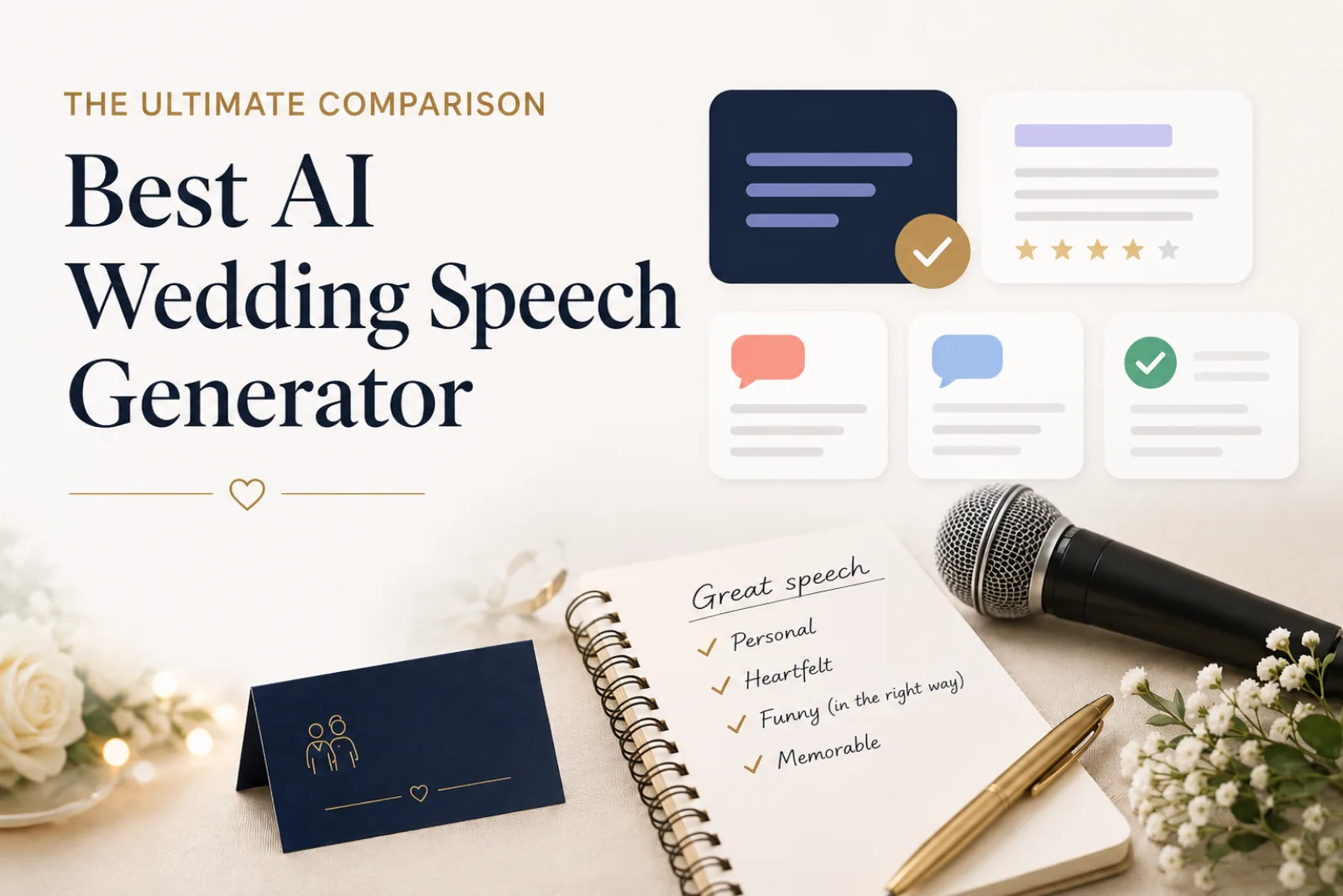
Best AI Wedding Speech Generator: Evermore vs ToastWiz, ToastPal, SpeechyAI, and ChatGPT
A side-by-side comparison of the top AI wedding speech generators — features, pricing, pros, cons, and which one fits your role and writing style.
Wedding Speeches · May 31, 2026
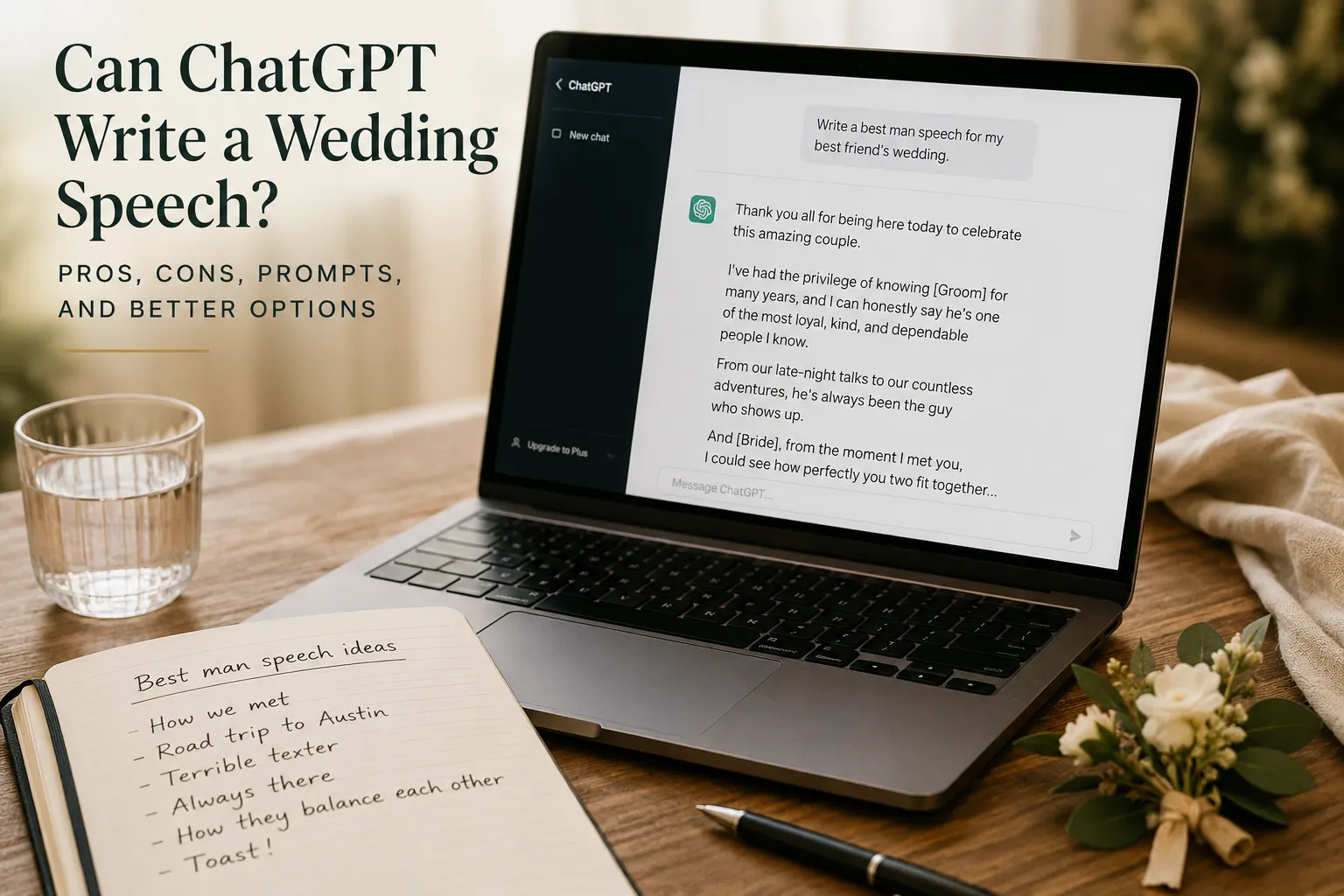
Can ChatGPT Write a Wedding Speech? Pros, Cons, Prompts, and Better Options
A fair, editorial buyer's guide to using ChatGPT for a wedding speech — where it helps, where it falls short, and when a dedicated wedding speech generator is the smarter starting point.
Speech Examples · May 2, 2026
10 Funny Wedding Speeches That Actually Work
Ten funny wedding speeches that actually work — embedded clips with sharp, tasteful commentary on why each one lands.
Speech Examples · May 2, 2026
How to Prepare a Wedding Speech
Preparation is the quiet stage that makes wedding speeches actually work. Here's how to gather the right material, choose your angle, and walk into the draft with a point — not a panic.
Speech Examples · April 19, 2026
Wedding Speech Examples for Every Role
Wedding speech examples for every role — best man, maid of honor, parents, and couples — with short samples, what makes each one work, and how to make yours sound like you.