Can ChatGPT Write a Wedding Speech? Pros, Cons, Prompts, and Better Options
By Morgan Reid · Etiquette Editor, Evermore
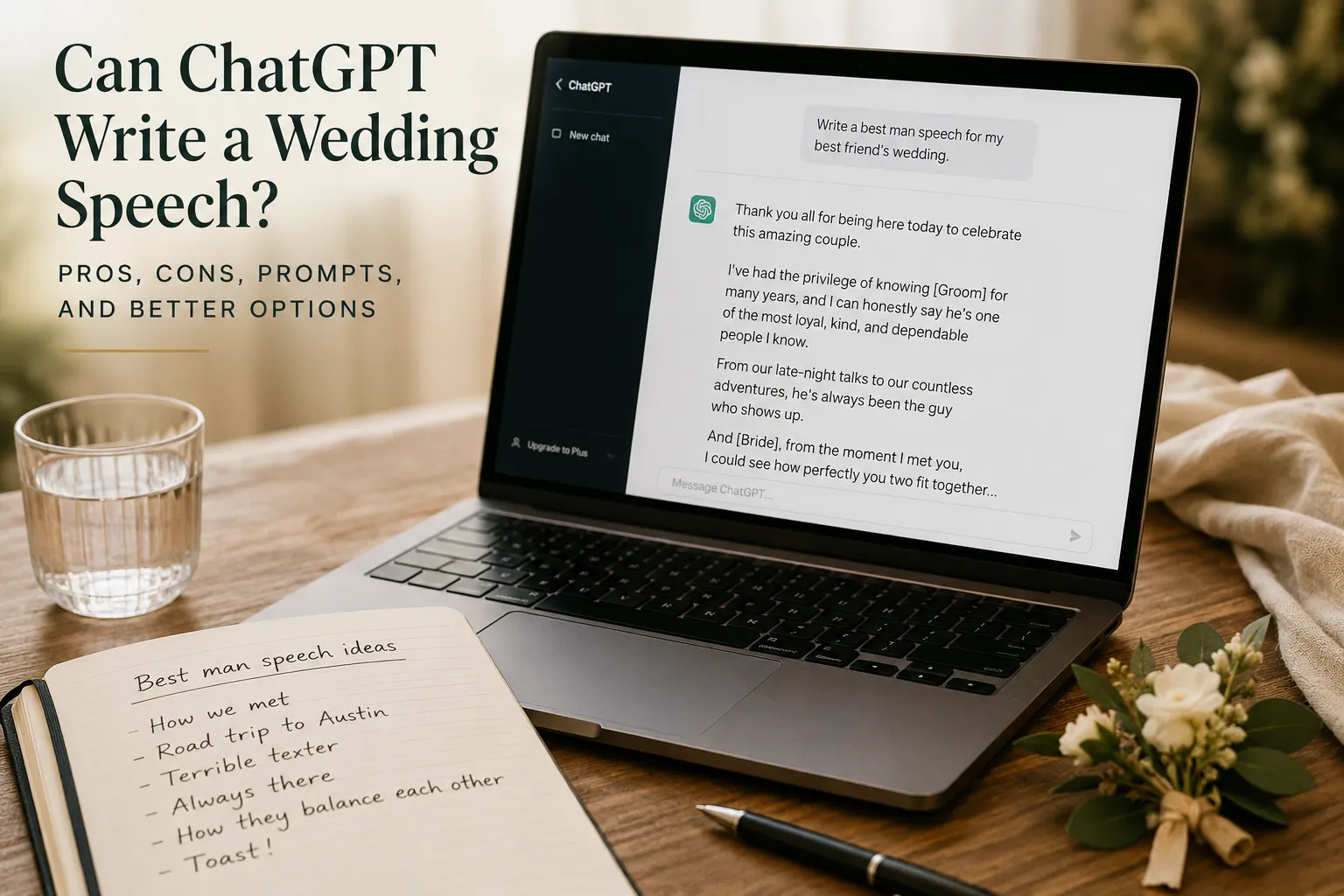
ChatGPT can write a wedding speech.
That is the easy part.
The harder question is whether it can write the wedding speech you actually need: one that sounds like you, fits your role, knows what to leave out, lands in the room, and does not accidentally turn a meaningful reception moment into a polished paragraph with no real pulse.
Wedding speeches are strange assignments. They look short from a distance. A few minutes. A microphone. A glass raised at the end. But inside those few minutes are several competing jobs. You need to honor the couple, represent your relationship honestly, keep the room with you, manage the tone, avoid private jokes that do not travel, and finish before the venue staff starts clearing plates with emotional force.
A general AI tool can help with parts of that. It can create structure. It can turn notes into paragraphs. It can suggest openings, make a draft shorter, soften a joke, or give you a starting point when the page has been blank for too long.
What it does not automatically understand is the social machinery of a wedding speech.
That is where dedicated wedding speech generators have a real advantage. They are built around the speech moment itself. They ask for role, relationship, tone, stories, audience, and the emotional shape of the speech before generating a draft. ChatGPT can do some of that if you know exactly what to ask for. Most people do not.
And when the wedding is close, "learn how to prompt a general AI assistant properly" is not usually the task anyone was hoping to add to the week.
Quick answer
Yes, ChatGPT can write a wedding speech. It can be useful if you are comfortable giving detailed instructions, editing the result, and judging what does or does not belong in a wedding room.
For most people, though, a dedicated wedding speech generator is the better option.
ChatGPT gives you a blank prompt box. A dedicated wedding speech tool gives you a guided process. That difference matters because most weak AI wedding speeches do not fail from lack of grammar. They fail because the prompt was too vague, the structure was too generic, the role was handled too broadly, or the final draft did not sound like the person delivering it.
A dedicated tool is usually stronger if you want:
- wedding-specific guidance
- role-based structure
- help choosing the right tone
- prompts that pull out useful personal details
- a draft shaped for a real reception
- less trial and error
- a clearer path from notes to finished speech
ChatGPT is better if you enjoy prompting, want total flexibility, and are confident editing. A dedicated tool is better if you want the shortest route to a speech that feels usable.
Skip the Blank Prompt Box
Evermore asks the wedding-specific questions first, then gives you a personalized speech draft to edit.
Try for free
Why people try ChatGPT for wedding speeches
The appeal is obvious.
Wedding speeches make people nervous, and ChatGPT is right there. It can produce a draft quickly. It can revise endlessly. It can change tone on command. It can make a speech shorter, warmer, funnier, more formal, more emotional, or less embarrassing, at least in theory.
For someone staring at a blank page, that feels like relief.
The first draft is often the hardest psychological barrier. Once something exists, even something imperfect, it becomes easier to react. You can say, "I would never say that," or "That story matters more," or "This needs to be less formal." ChatGPT can get you to that reaction point fast.
It can also help if you already know what you want. If you have a clear story, a defined tone, and a good sense of the audience, ChatGPT can help organize the material. It can create a clean speech shape. It can suggest transitions. It can tighten a rambling paragraph.
So the issue is not that ChatGPT is useless for wedding speeches. It is that it asks the user to be the strategist.
And many wedding speakers are not looking for a strategy project. They are looking for a speech.
Where ChatGPT usually falls short
ChatGPT is general-purpose. That is its strength and its weakness.
It can help with almost anything, but it does not automatically know the difference between a best man speech that should be lightly teasing and a father of the bride speech that needs tenderness, restraint, and welcome. It does not automatically know whether your "funny" story is safe for grandparents, whether your sibling memory sounds too private, or whether the groom has been reduced to a supporting character in a speech that should celebrate a couple.
Those decisions matter.
A wedding speech is not just writing. It is social judgment in written form.
Common ChatGPT wedding speech problems include generic praise, over-polished language, safe but forgettable jokes, sentimental phrasing that feels borrowed, and speeches that sound good on screen but stiff aloud. The draft may look complete because the sentences flow. Then you read it into the room in your mind and realize it sounds like someone delivering a corporate tribute to affection.
That is the danger of fluency.
ChatGPT can write fluent language very easily. Wedding speeches need more than fluent language. They need fit.
The real problem: ChatGPT needs a better prompt than most people give it
A prompt like this will usually create a weak speech:
Write a funny best man speech for my friend.
There is not enough there. ChatGPT can fill the silence, but it has to invent the emotional shape from almost nothing. The result will likely include familiar lines about friendship, loyalty, laughter, love, and raising a glass. Nothing will be especially wrong. Nothing will be especially yours.
A stronger prompt would include role, relationship, stories, tone, length, audience, what to avoid, and what the speaker wants the room to feel.
For example:
I'm giving a best man speech for my friend Daniel. We met in university and have been close for 12 years. He is dry, loyal, terrible at replying to texts, but always shows up when it matters. I want the speech to be funny but not roast-heavy. His partner Maya is warm, direct, and makes him more relaxed. Include one story about a chaotic road trip but keep it wedding-appropriate. Make it about four minutes, conversational, and end with a toast.
That prompt is much better. It gives ChatGPT actual material to work with.
But notice what happened. The user had to understand what details mattered. They had to know the right tone. They had to define the role. They had to identify the usable story. They had to warn against the wrong kind of humor.
That is exactly the work a dedicated wedding speech generator is designed to guide.
ChatGPT vs a dedicated wedding speech generator
Here is the cleanest way to think about it.
| Question | ChatGPT | Dedicated wedding speech generator |
|---|---|---|
| Does it know this is a wedding speech? | Only after you explain it | Yes |
| Does it guide you by role? | Only if prompted | Usually yes |
| Does it ask for the right memories? | You need to provide them | Built into the flow |
| Does it know what tone fits the role? | It can, with guidance | Usually part of the product logic |
| Does it reduce blank-page stress? | Yes | Yes, often more directly |
| Does it require prompt skill? | Yes | Much less |
| Does it produce a wedding-specific draft quickly? | Sometimes | That is the purpose |
| Is it best for non-writers? | Mixed | Usually stronger |
ChatGPT is like being given an empty kitchen and every ingredient imaginable. A dedicated generator is more like being handed a recipe designed for the dish you actually came to make.
For confident writers, the empty kitchen can be fun. For most people giving a wedding speech, the recipe is more useful.
If you want to compare dedicated options directly, our guide to the best AI wedding speech generator breaks down how wedding-specific tools differ.
Use a Tool Built for Wedding Speeches
Get a draft shaped around your role, relationship, stories, and tone.
Try for free
Why role-specific guidance matters
A wedding speech is shaped by who is speaking.
A best man has permission to be funnier, but not careless. A maid of honor can be intimate, but still needs to include the partner. A father of the bride may need to hold pride, emotion, humor, and welcome in one speech. A sibling can use family history, but has to avoid making the room feel excluded. A groom may need to thank people, honor his partner, and avoid sounding like he is reading a logistics memo with feelings attached.
These are different assignments.
ChatGPT can handle those differences if the user names them and gives enough direction. The problem is that people often do not know what the differences are until the first draft feels wrong.
That is where role-specific product flows matter. A tool like Evermore's father of the bride speech generator can focus on the particular emotional balance of that role: pride without overstatement, humor without undermining the moment, and a warm welcome to the couple's future. A generic prompt may not naturally pull those things out.
The same applies to best man speech and maid of honor speech pages. The role is not just a label. It changes the kind of speech the room expects.
Can ChatGPT write a best man speech?
Yes, but it often needs a lot of steering.
Best man speeches are especially easy for AI to mishandle because "funny" is not specific enough. ChatGPT may produce safe jokes that feel bland, or it may lean on familiar ideas about embarrassing stories, friendship, and the groom being lucky. It can write something passable, but a good best man speech needs a sharper sense of what kind of humor fits the groom and the room.
A strong best man speech usually needs one or two stories that reveal character. It should tease with affection, include the partner properly, and end before the jokes start feeling like a routine. ChatGPT can help with structure, but the speaker still has to supply judgment.
A dedicated best man flow is usually better because it is built around that balance from the start.
Can ChatGPT write a maid of honor speech?
Yes, though it often becomes too polished or too broadly emotional unless guided carefully.
Maid of honor speeches can sound generic when the prompt only says the bride is kind, beautiful, and amazing. The speech needs texture: friendship, loyalty, small habits, shared history, the couple's dynamic, and a tone that fits the speaker. It also needs to avoid becoming a speech only about the bride, with the partner tacked on at the end.
ChatGPT can improve a draft and help with phrasing. But if the speaker wants something that feels like a real maid of honor speech rather than a general tribute, a dedicated role-specific flow will usually ask better starting questions.
Can ChatGPT write a father of the bride speech?
It can, but this is one of the roles where a dedicated tool has an especially clear advantage.
A father of the bride speech has a narrow emotional lane. Too formal and it feels distant. Too emotional and it can overwhelm the room. Too jokey and it can miss the weight of the moment. Too much childhood and the bride can feel frozen as a little girl rather than honored as the person she is now.
ChatGPT may produce a sweet draft, but it often needs careful editing to avoid familiar father-speech clichés. A dedicated father of the bride generator can better guide the speaker toward the right mix of warmth, memory, welcome, and restraint.
That kind of role-specific guidance matters because the speech is often one of the most visible emotional moments of the reception.
What a good ChatGPT prompt needs
If you are going to use ChatGPT, give it more than a role and a tone.
A useful prompt should include:
| Detail | Why it matters |
|---|---|
| Your role | Sets expectations for tone and content |
| Relationship | Helps shape emotional closeness |
| Stories | Prevents generic output |
| Couple dynamic | Keeps the speech wedding-focused |
| Audience | Helps avoid risky jokes or private references |
| Desired length | Prevents rambling |
| Tone | Guides humor, emotion, and formality |
| What to avoid | Reduces awkward or cliché material |
A strong prompt might look like this:
Write a four-minute father of the bride speech. I want it warm, lightly funny, and not overly sentimental. My daughter Emma is thoughtful, stubborn in a good way, and quietly generous. I want to mention how she used to plan everything as a child, but connect it to the capable woman she is now. Her partner James is calm, kind, and brings out a relaxed side of her. Avoid clichés about giving her away. Include a short welcome to James and end with a toast.
That is much better than "write a father of the bride speech."
It is also a lot of work for someone who wanted help because they did not know where to start.
Why dedicated tools often produce a better first draft
The biggest advantage of a dedicated wedding speech generator is not magic. It is structure.
A good tool asks better questions before generating the draft. It knows that the role matters. It knows that examples, stories, tone, and relationship details matter. It knows that a speech should be sayable aloud. It knows that most users need help deciding what belongs and what should be left out.
That changes the output.
A dedicated tool reduces the chance that the user accidentally under-prompts. It also reduces the editing burden because the draft is already aimed at the right kind of moment.
That does not mean every draft will be perfect. No AI tool can know everything from a few inputs. But a wedding-specific flow usually gets closer faster because it is designed for the exact use case.
For most users, that is more valuable than raw flexibility.
When ChatGPT is still useful
ChatGPT can still be useful after you have a draft.
It can help you:
- shorten a speech
- make a line simpler
- create alternate endings
- make a joke softer
- turn formal language into conversational language
- check whether a speech is too long
- brainstorm toast wording
It is often strongest as an editing assistant after the speaker already has the main shape. That is a different use case from relying on it to create the whole speech from a vague prompt.
If you already have a draft and are comparing options, our guide to how much a wedding speechwriter costs can also help you decide whether you need a tool, an editor, or full human writing support.
How to judge any AI-generated wedding speech
Whether you use ChatGPT or a dedicated generator, the final speech should pass a few tests.
Does it sound like the speaker? Does it include at least one detail that could only apply to this person or couple? Does the humor feel kind? Does the partner appear as more than a courtesy mention? Is it short enough to keep the room? Does the ending actually end?
Most AI drafts need editing. That is normal.
The danger is accepting a speech because it sounds smooth. Smooth is not the same as good. A wedding speech can be slightly plain and still wonderful if the details are true. It can be beautifully phrased and still forgettable if it never gets specific.
Reading strong wedding speech examples can help you hear the difference between a speech that is merely polished and one that actually feels like someone speaking from real knowledge.
The best workflow: dedicated generator first, ChatGPT only if needed
For most people, the smartest workflow is not "ChatGPT or nothing."
It is:
- Use a dedicated wedding speech generator to create the first real draft.
- Read the draft aloud.
- Add or adjust personal details.
- Cut anything that sounds unlike you.
- Use ChatGPT only for small edits if needed.
- Practice the final version.
That order matters.
Starting with a dedicated tool gives you wedding-specific structure from the beginning. Using ChatGPT afterward for small refinements can be helpful, but it should not replace the guided thinking that gets the draft pointed in the right direction.
In other words, let the wedding-specific tool do the wedding-specific job.
Should you tell people you used ChatGPT?
Usually, no one needs a production note.
The speech should stand on its own. People do not typically announce that they used examples, templates, a friend's feedback, a speechwriter, or three late-night drafts in a notes app. The important thing is whether the final speech is thoughtful and appropriate.
That said, you should feel comfortable with the process. If using AI makes you feel like you skipped the emotional work, go back and add more of yourself. The best AI-assisted speeches still have human fingerprints: a real memory, a real observation, a real choice about what to say and what to leave out.
So, can ChatGPT write a good wedding speech?
Yes, but it is rarely the easiest route for most people.
ChatGPT can produce a wedding speech. A strong user can make it produce a good one. But the user has to know what to ask for, what to avoid, how to edit, and how to judge whether the result works for the actual room.
A dedicated wedding speech generator is usually better for people who want guidance rather than a blank prompt box. It starts closer to the real task. It understands the category. It prompts for the details that make the speech personal, structured, and appropriate. It makes the user less responsible for knowing the invisible rules of wedding speechwriting before they have even begun.
ChatGPT is flexible. Dedicated tools are focused.
For wedding speeches, focus usually wins.
Frequently asked questions
Can ChatGPT write a wedding speech?
Yes. ChatGPT can write a wedding speech if you give it enough detail about your role, relationship, stories, tone, audience, and desired length. The result usually needs editing before it is ready to deliver.
Is ChatGPT good for best man speeches?
ChatGPT can help with a best man speech, especially for structure and drafting. It often needs careful prompting so the humor stays affectionate, the stories are appropriate, and the partner is included properly.
Is ChatGPT good for maid of honor speeches?
ChatGPT can draft a maid of honor speech, but vague prompts often lead to generic emotional language. A strong speech needs specific memories, natural tone, and a clear sense of the bride and couple.
Is ChatGPT good for father of the bride speeches?
ChatGPT can help, but father of the bride speeches are emotionally delicate. A dedicated father of the bride speech generator is often better because it guides the speaker through the role's specific balance of pride, memory, welcome, and restraint.
Is a dedicated wedding speech generator better than ChatGPT?
For most users, yes. A dedicated wedding speech generator is usually better because it asks wedding-specific questions, supports different roles, and reduces the need for prompt-writing skill.
Can people tell if a wedding speech was written by AI?
They may not know exactly, but they can often sense when a speech is generic or overly polished. The best way to avoid that is to include real stories, natural wording, and details only you would know.
Should I use ChatGPT or Evermore?
Use ChatGPT if you are comfortable prompting and editing. Use Evermore if you want a guided wedding-specific flow that helps create a personalized draft based on your role, relationship, memories, and tone.
Final thoughts
ChatGPT can help with a wedding speech, but it does not remove the need for taste, judgment, and real material.
That is why dedicated wedding speech tools are usually the better starting point. They narrow the task before the writing begins. They ask more relevant questions. They understand that a wedding speech is not just a paragraph about love; it is a role-specific, room-specific, relationship-specific moment.
A blank prompt box can work for someone who knows how to steer it. Most wedding speakers need something more guided.
Start with the tool that understands the occasion. Add the memories only you can provide. Read the result aloud. Edit until it sounds like you.
That is how AI becomes useful without taking over the part that still matters most.
Start Your Wedding Speech
Answer a few questions, preview your draft, and edit until it sounds like you.
Try for free
Related Articles
Speech Examples · May 2, 2026
How to Write a Wedding Speech: Clear Process
A clear, practical process for writing a wedding speech from scratch — structure, tone, story selection, editing, and wording help that sounds like you.
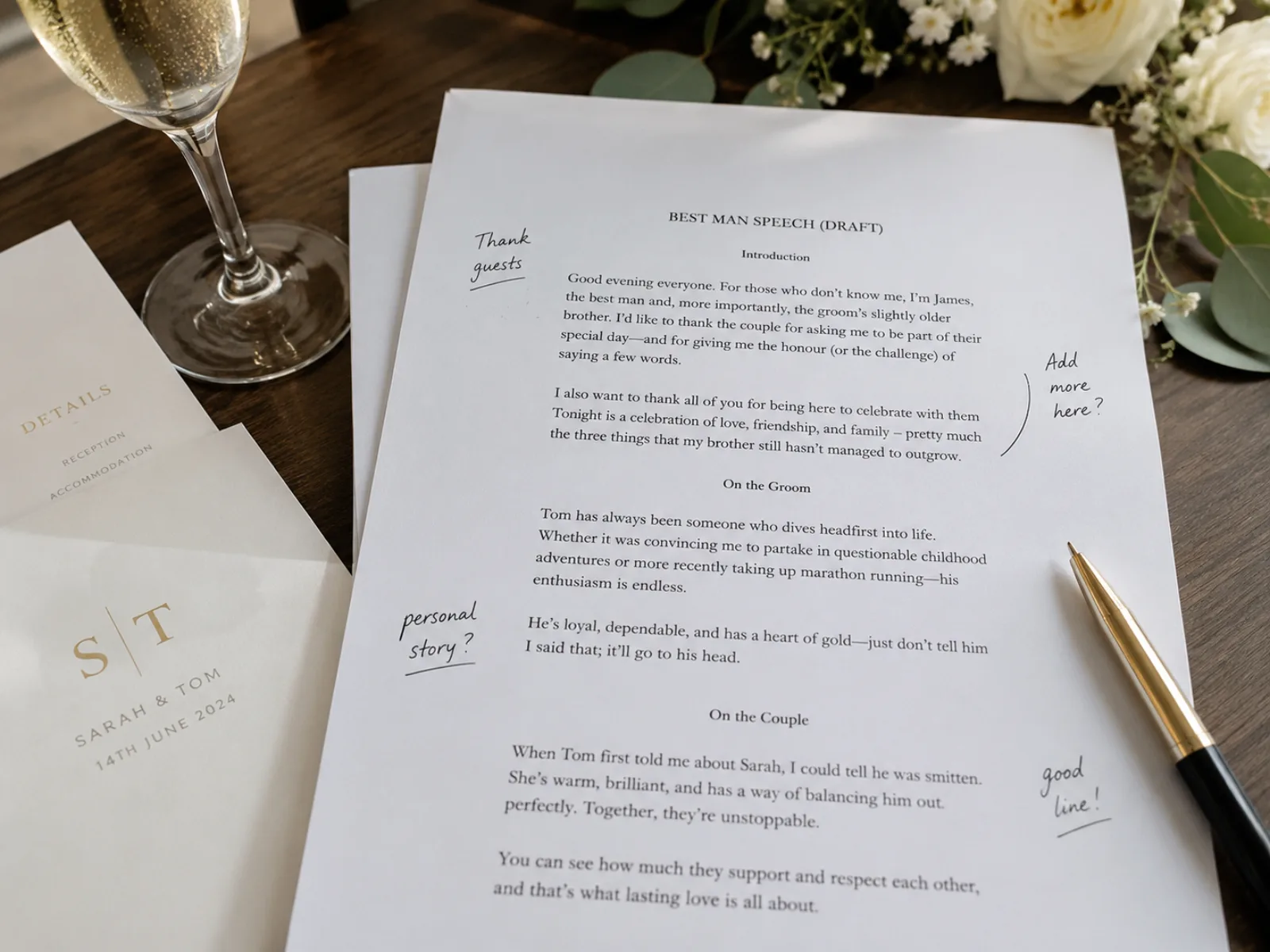
Wedding Speeches · May 21, 2026
How Much Should You Spend on a Wedding Speechwriter?
A practical buyer's guide to wedding speechwriter pricing — typical ranges, what affects cost, when premium services are worth it, and cheaper alternatives that often work.
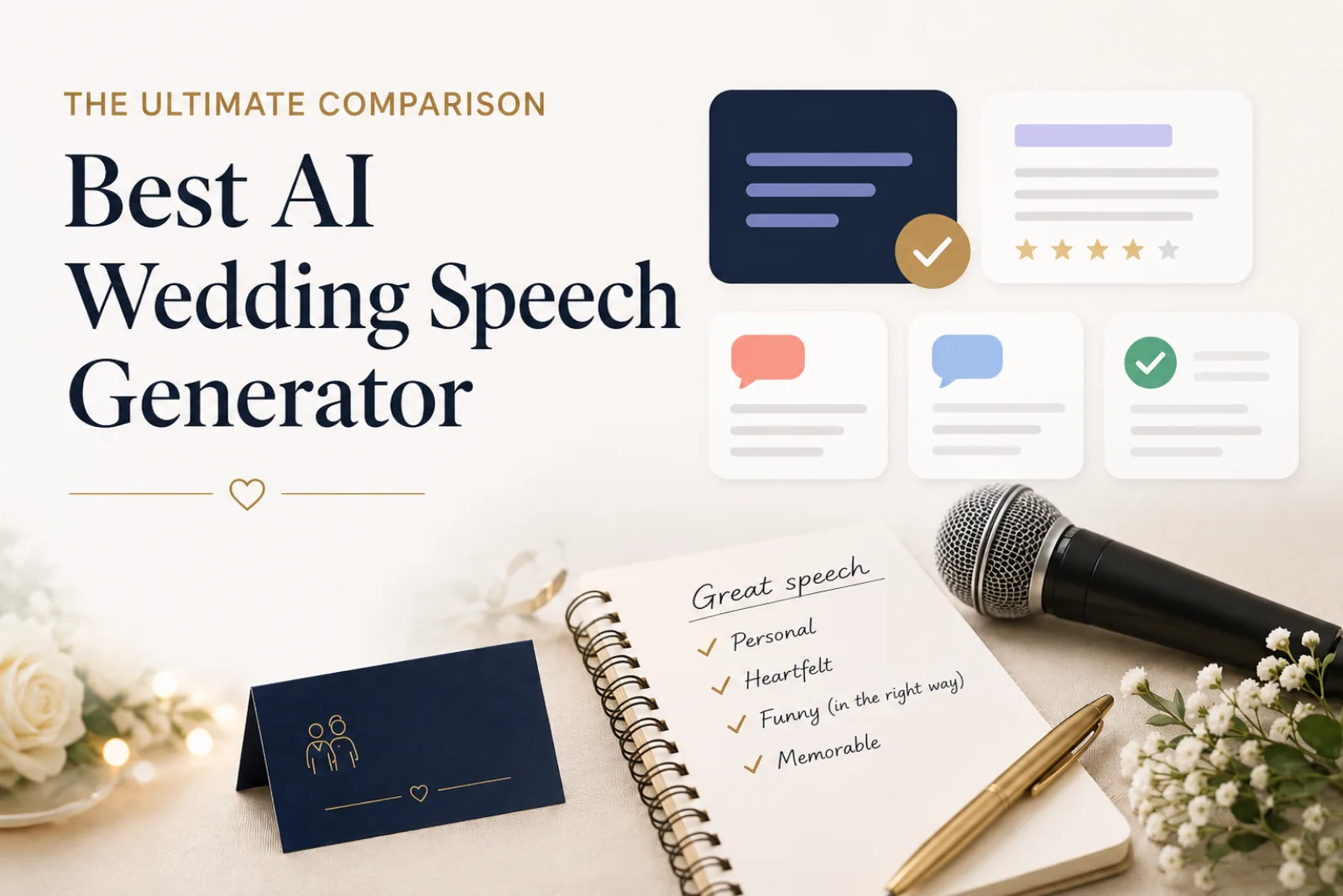
Wedding Speeches · May 29, 2026
Best AI Wedding Speech Generator: Evermore vs ToastWiz, ToastPal, SpeechyAI, and ChatGPT
A side-by-side comparison of the top AI wedding speech generators — features, pricing, pros, cons, and which one fits your role and writing style.
Speech Examples · May 2, 2026
10 Funny Wedding Speeches That Actually Work
Ten funny wedding speeches that actually work — embedded clips with sharp, tasteful commentary on why each one lands.
Speech Examples · May 2, 2026
How to Prepare a Wedding Speech
Preparation is the quiet stage that makes wedding speeches actually work. Here's how to gather the right material, choose your angle, and walk into the draft with a point — not a panic.
Speech Examples · April 19, 2026
Wedding Speech Examples for Every Role
Wedding speech examples for every role — best man, maid of honor, parents, and couples — with short samples, what makes each one work, and how to make yours sound like you.