How to Prepare a Wedding Speech
By Morgan Reid · Etiquette Editor, Evermore
Some wedding speeches go wrong long before the person ever stands up to give them.
They go wrong when someone opens a blank document too early.
That is usually the moment the whole thing starts to wobble. Not because they are incapable of writing, exactly. More because they have skipped the stage that makes writing possible. They have gone straight from "I need to give a speech" to "I should probably start drafting" without doing the quieter work in the middle: deciding what kind of speech this is, what belongs in it, what definitely does not, what the room actually needs from them, and which stories are strong enough to survive being told in public with a microphone in one hand and family members in direct view.
That middle stage is preparation, and it matters more than people think.
A lot of advice about wedding speeches jumps straight into structure or wording. Useful, up to a point. But many people do not fail because they lack a template. They fail because they arrive at the template with a bag full of unmanaged material. Too many memories. Too many possible jokes. Too much pressure to sound moving. Too little clarity on what their actual job is. So they start writing from a fog and then wonder why the draft sounds like three different people trying to give the same speech.
This page is here to stop that happening.
Not to write the speech for you. Not to compete with a true wedding speech template. Not to duplicate the full drafting process from how to write a wedding speech. This page comes before that. It is about preparation: how to gather what you need, narrow it properly, understand the room, and walk into the writing stage with something much more useful than panic and an overestimated anecdote.
If you prepare well, the speech gets easier. Not effortless. Just easier in all the ways that matter.
Start Your Wedding Speech
Answer a few questions and get a personalized wedding speech in minutes.
Try for free
Start by figuring out what your job actually is
This sounds obvious, but it is where plenty of speeches quietly lose the plot.
Before you write anything, you need a clearer answer to one question:
What is my job in this room?
Not your formal title. Your actual job.
Because "best man," "groom," "sister," and "friend" are not enough by themselves. Two people with the same role can still be doing slightly different jobs depending on:
- the tone of the wedding
- who else is speaking
- how long the speech needs to be
- how close they are to the couple
- what kind of person they naturally are
- what the room already knows
- and whether they are supposed to lift the energy, add warmth, welcome people, or carry more emotional weight
A useful way to prepare is to choose your main function before you choose your words.
You might be there to:
- welcome and settle the room
- say something deeply affectionate
- make people laugh without hijacking the evening
- speak as family and give context
- say the thing people close to the couple all know, but have never heard phrased out loud
- add one warm, specific layer to the overall picture of the couple
Most speeches only need one or two of those jobs. They get messy when they try to do all of them.
If you are speaking in a specific role, the role-specific pages are useful here too — for example best man speech, maid of honor speech, father of the bride speech, groom speech, or bridesmaid speech. Knowing what your role is usually expected to do makes it easier to decide what yours, specifically, will not.
Work out the tone before the content
This is another stage people skip.
They assume tone will emerge naturally once they start writing. Sometimes it does. More often, the draft becomes a tug-of-war between the voice they actually have and the voice they think a wedding requires.
It helps to decide early whether your speech is meant to feel:
- warm
- lightly funny
- more sincere than witty
- dry and affectionate
- calm and polished
- brief and confident
- more tribute-led
- more host-like
You are not choosing a costume. You are choosing a lane.
Because preparation is partly about preventing tonal panic. If you know, for example, that your speech should be:
- warm, but not gushy
- funny, but not roast-adjacent
- sincere, but not poetic
- grateful, but not long-winded
then you already know what to leave out before you start.
That is one of the hidden advantages of preparation: it reduces the number of wrong directions available to you.
Decide what the speech is about in one sentence
This may be the most useful prep step on the page.
Before you draft, force yourself to finish this sentence:
At its core, this speech is about…
Not the whole wedding.
Not your full relationship history.
Not all the reasons the person is wonderful.
Just one thing.
Examples:
- …what it has always felt like to know him.
- …the kind of steadiness she brings to people's lives.
- …why these two feel so right together.
- …what I have always admired most about my brother.
- …how she makes everyone around her feel more at ease.
- …how he became the person everyone quietly relies on.
This is not your title. It is your anchor.
Without it, preparation turns into collection. You gather stories, lines, jokes, bits of gratitude, vague emotional statements, and none of them know what they are serving. With it, you can start filtering material instead of hoarding it.
That is the difference between "I have a lot to say" and "I know what I'm saying."
Make a raw list before you make choices
At this stage, do not try to sound good. Try to get material out where you can see it.
Write down:
- 5 to 10 words that describe the person or couple
- 3 to 5 memories
- 3 things you genuinely admire
- 2 moments that reveal character
- 2 things you absolutely should not say
- 1 line about how the partner changed or complements the person
- 1 thing you want the room to feel when you finish
This is where a lot of useful speech preparation happens. Not in composing, but in uncrowding your own head.
You may discover:
- your best material is not your funniest material
- your clearest point is more grown-up than the story you thought you'd tell
- one memory keeps proving the same thing as another, only better
- you have more gratitude than story, or more story than structure
- the actual center of the speech is not what you assumed
All useful discoveries. All easier to make before the draft exists.
Pick one story, not the whole archives
Most people overprepare in the wrong direction.
They think preparation means collecting as many stories as possible. In reality, the harder and more valuable part is selection.
A wedding speech does not need your best ten memories. It usually needs one or two that actually do something.
A strong prep question is: Which story proves the point most cleanly?
Not:
- Which story is funniest to me?
- Which story has the most history?
- Which story shows how long we've known each other?
- Which story would kill at brunch with the three people who were there?
The right story is usually the one that:
- reveals character
- makes sense quickly
- sounds good aloud
- does not require footnotes
- leaves the person looking more lovable, not less
That is a very different standard from "good story."
Preparation is where you make that distinction. If you want to see how finished speeches actually use stories like this, wedding speech examples is a useful reference once you have made your selection — though for now, stay in selection mode rather than comparison mode.
Create Your Wedding Speech
Get a personalized draft based on your role, memories, and tone.
Try for free
Make a "must include" list and a "not for public use" list
This step is boring. It is also strangely effective.
Before writing, make two columns.
Must include
These are the things the speech would feel incomplete without.
Examples:
- mention of the bride or groom's key trait
- one short memory
- one line about the partner
- thanks to parents
- clear toast
- one light joke
Not for public use
These are the things that should stay out, even if they are funny, emotionally loaded, or hard to resist.
Examples:
- private stories that need too much context
- references that only four people understand
- anything embarrassing enough to shift the room
- family politics
- exes, unless you have lost all sense of proportion
- in-jokes that flatten the speech for everyone else
- lines that sound good in your head but dreadful in your own voice
This list does something useful: it protects the future draft from your weaker instincts before they have a chance to dress themselves up as sincerity or spontaneity.
Think about the room before the speech
A lot of wedding speech advice treats the audience as a blur. That is not how the room actually works.
The room matters.
Preparation gets better when you ask:
- Who is in the room?
- What do they already know?
- What do they not know?
- How mixed is the audience?
- How formal is the evening?
- Are there children? grandparents? work friends? very different groups colliding?
- Will the room respond better to dry humor, warmth, brevity, or more polish?
This does not mean pandering. It means judgment.
A good wedding speech is not only about the speaker and the subject. It is also about what kind of social experience the room is having. A speech can be deeply personal and still considerate of the fact that not everyone in the audience shares the same backstory.
That is why preparation should include the audience. Otherwise you end up writing something that feels emotionally correct in private and socially odd in public.
Decide the shape before the words
This is where preparation starts saving real time.
Before you draft sentences, sketch the shape of the speech in plain language.
For example:
- open simply
- say who I am
- say what I admire
- tell one story
- say something about the couple
- thank people briefly
- close with a toast
Or:
- welcome room
- thank parents
- thank guests
- talk about partner
- end short
Or:
- brief joke
- sincere point
- one sibling memory
- line about partner
- toast
The point is not elegance. The point is sequence.
This is different from a template. A template gives you finished-ish wording and a fill-in-the-blank structure — that is the job of our wedding speech template. Preparation gives you the shape of your speech before the wording begins. The two pages do related but separate work.
Think about length before you write, not after
People are much worse at estimating speech length than they think.
Preparation gets much better when you decide in advance:
- roughly how long should this be?
- how many speeches are there?
- how much room do I actually have?
- am I someone who sounds better shorter?
This is especially helpful because some people draft long out of anxiety. They think more material means more safety. Usually it just creates more places to go wrong.
A useful prep rule:
- if your role is lighter, prepare lighter
- if your role carries more formal weight, still do not assume longer is better
- if you are nervous, brevity is often your ally
- if you have one good story and one good point, that may genuinely be enough
Preparation is where you stop the speech from quietly turning into a ten-minute project when what the evening needed was four strong minutes and a sense of proportion.
Collect phrases, not paragraphs
This is a very good preparation trick if you freeze at blank pages.
Do not try to draft full sections yet. Collect small usable phrases.
For example:
- "what I've always admired about him…"
- "the thing about her that people notice immediately…"
- "one of my favorite things about the two of them…"
- "it says a lot about who he is that…"
- "watching them together, it's obvious that…"
- "what makes this feel so right is…"
These are not template lines in the full sense. They are handles.
They help because they give the eventual draft something to grab onto without forcing you into complete sentences too early. Some people write much better once they have a bank of good beginnings and transitions ready to go. The actual stitching of these into paragraphs belongs in the writing stage — see how to write a wedding speech for that part.

Prepare the delivery while you prepare the content
This is not a full delivery page. But it belongs here because some speech problems are really preparation problems wearing performance clothes.
If part of what you are weighing in this preparation stage is whether to bring in outside help, our breakdown of how much you should spend on a wedding speechwriter is a useful sanity check before you commit to anything paid.
Before writing, be honest about:
- Are you reading from notes?
- Are you using your phone or paper?
- Will you likely speak faster than you think?
- Are you someone who sounds better with simpler sentences?
- Are there names you should spell phonetically for yourself?
- Is there a line that will probably make you emotional and needs space around it?
These decisions should influence the speech before it is written.
For example:
- if you know you rush, prepare shorter sentences
- if you know you are emotional, avoid stacking three sentimental lines in a row
- if you know you are dry and understated, do not force big expressive language
- if you know you are not naturally formal, do not build a speech you will have to impersonate
This is all preparation. It is not glamorous. It is incredibly practical.
What to do when you feel like you have nothing good
Usually that feeling is misleading.
What people often mean is:
- nothing sounds polished yet
- the good material still looks ordinary
- the memories feel too small
- the qualities feel too simple
But wedding speeches rarely improve by becoming grander. They improve by becoming better chosen.
A "small" truth often makes a stronger speech than a dramatic one.
For example:
- he shows up quietly
- she makes people feel instantly welcome
- they make each other calmer
- he's funnier when he's relaxed with her
- she notices the right things
- he has grown into himself in a way that's hard not to admire
Those may not look impressive in your notes. They often sound much better in a speech than whatever larger, fuzzier line you were trying to force.
Preparation is partly about trusting what is plain but true.
When you are prepared enough to start writing
This matters, because preparation can also become procrastination with better stationery.
You are ready to draft when you have:
- a clear sense of your role in the room
- the tonal lane
- one central point
- one or two stories or reflections
- a rough shape
- a sense of length
- a short list of must-include things
- and a clear list of what to leave out
At that point, stop preparing and start writing.
Not because everything is solved. Because the important unknowns are now small enough to survive a draft.
That is the point of preparation: not to remove all difficulty, but to stop you writing from total fog.
If you are tempted to outsource the whole thing to a chatbot, it is worth reading our take on the best AI wedding speech generators before you paste anything in — the short version is that generic AI drafts almost always need rewriting by hand.
Frequently asked questions about how to prepare a wedding speech
Is preparing a wedding speech different from writing one?
Yes. Preparation is what you do before drafting: choosing the point, tone, material, and shape. Writing is when you actually turn that into sentences.
How far in advance should I prepare?
Earlier than you think, but not so early that you feel obliged to write the whole thing immediately. A little planning in advance makes the draft much easier later.
How many stories should I prepare?
Gather several if you want, but expect to use one or two at most. The useful part is selection, not accumulation.
What should I do before using a speech template?
Know your role, tone, central point, and best material. Templates work much better when you already understand what kind of speech you're trying to build.
What if I'm not sure what the speech is about yet?
That is exactly what preparation is for. Start with qualities, memories, and one sentence about what you want the room to feel. The center usually shows up from there.
Can preparation help with nerves?
Yes. A lot. Many nerves come from vagueness. Clarity reduces them.
Final thoughts
The best wedding speeches are not always written by the most naturally eloquent people.
They are often written by the people who prepared well enough to know what mattered before they started chasing the perfect line.
That is the whole advantage.
Preparation helps you:
- choose instead of dump
- shape instead of ramble
- sound like yourself instead of a wedding-content impersonator
- and walk into the draft with a point, not just a problem
Once you have that, the actual writing gets much easier.
And if you want help turning all that preparation into a speech that actually sounds like you, Evermore's wedding speech generator can help do the final lift.
If your nerves are the part you're most worried about, Toastmasters International on calming pre-speech nerves has a few practical techniques worth borrowing.
Need help writing the actual speech?
If you have the ideas but do not want to wrestle them into a draft alone, Evermore can help.
With Evermore, you can:
- answer a few thoughtful questions
- choose your tone
- get a personalized draft
- revise until it feels right
- preview it before you pay
It is the easiest way to turn good preparation into a speech you would genuinely feel good saying.
Generate Your Wedding Speech Now
See your preview before you pay.
Try for free
Related Articles
Speech Examples · May 2, 2026
10 Funny Wedding Speeches That Actually Work
Ten funny wedding speeches that actually work — embedded clips with sharp, tasteful commentary on why each one lands.

Speech Examples · May 2, 2026
How to Write a Wedding Speech: Clear Process
A clear, practical process for writing a wedding speech from scratch — structure, tone, story selection, editing, and wording help that sounds like you.
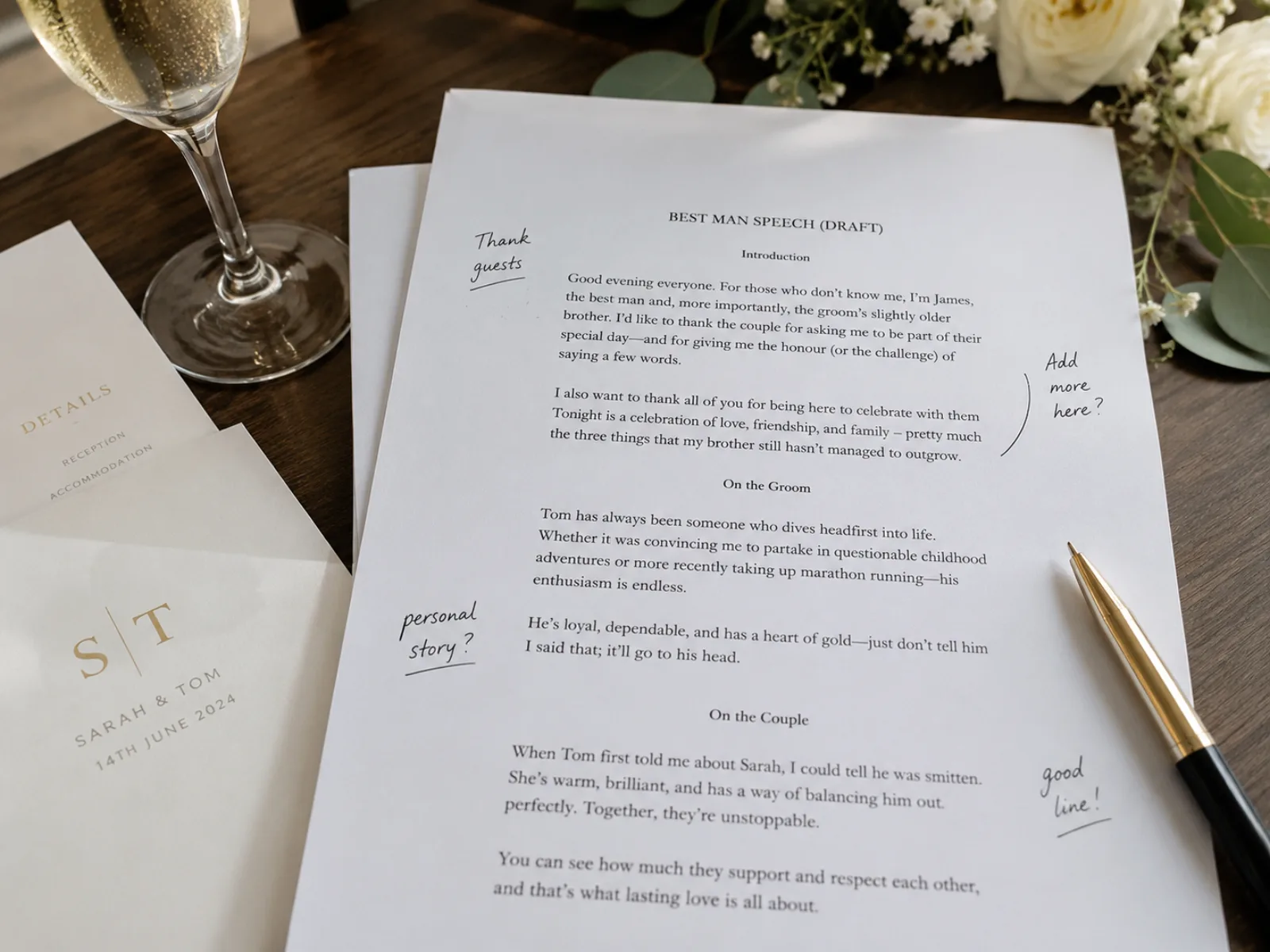
Wedding Speeches · May 21, 2026
How Much Should You Spend on a Wedding Speechwriter?
A practical buyer's guide to wedding speechwriter pricing — typical ranges, what affects cost, when premium services are worth it, and cheaper alternatives that often work.
Wedding Speeches · May 29, 2026
Best AI Wedding Speech Generator: Evermore vs ToastWiz, ToastPal, SpeechyAI, and ChatGPT
A side-by-side comparison of the top AI wedding speech generators — features, pricing, pros, cons, and which one fits your role and writing style.
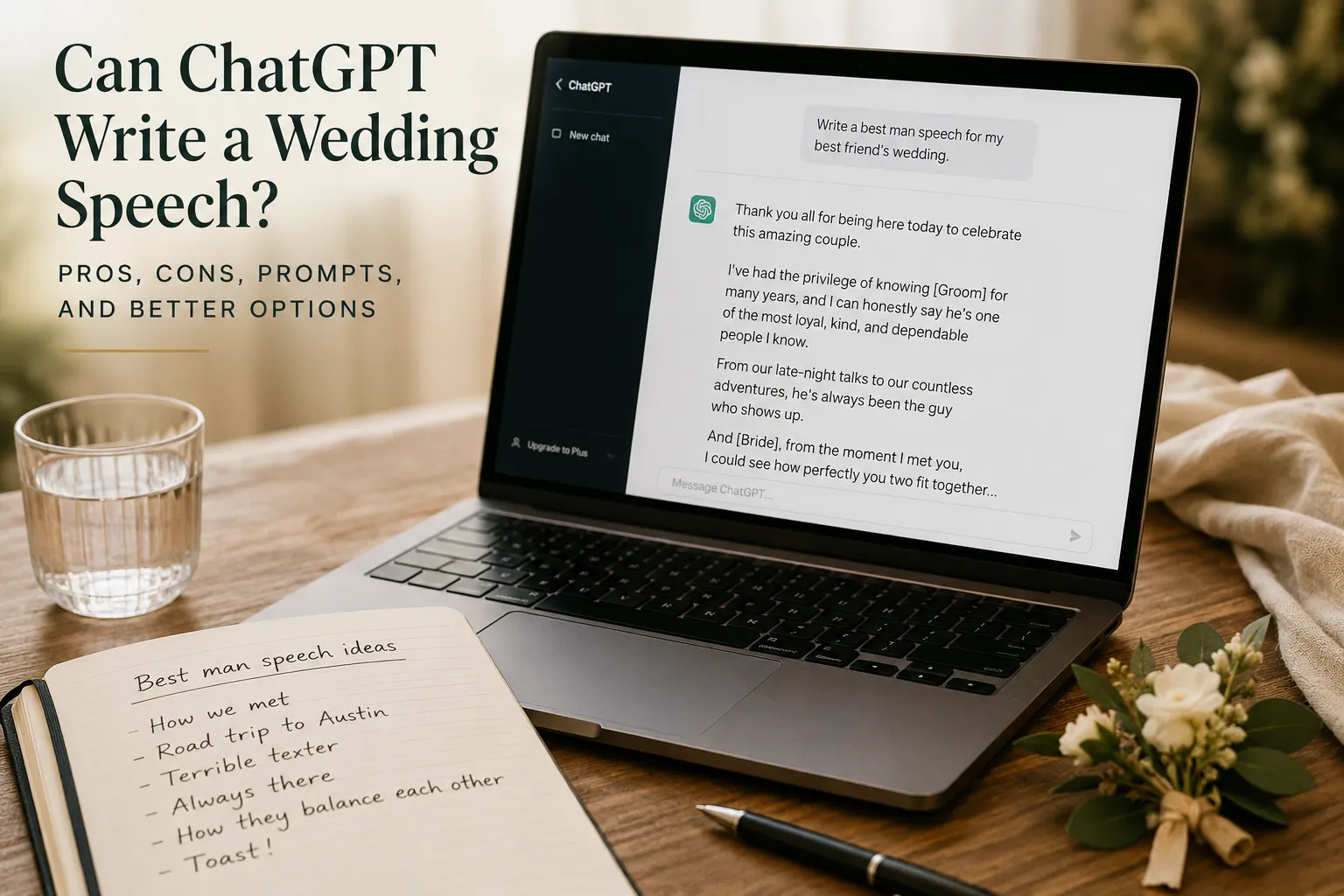
Wedding Speeches · May 31, 2026
Can ChatGPT Write a Wedding Speech? Pros, Cons, Prompts, and Better Options
A fair, editorial buyer's guide to using ChatGPT for a wedding speech — where it helps, where it falls short, and when a dedicated wedding speech generator is the smarter starting point.
Speech Examples · April 19, 2026
Wedding Speech Examples for Every Role
Wedding speech examples for every role — best man, maid of honor, parents, and couples — with short samples, what makes each one work, and how to make yours sound like you.