Wedding Ceremony Script: Structure & Wording
By Morgan Reid · Etiquette Editor, Evermore
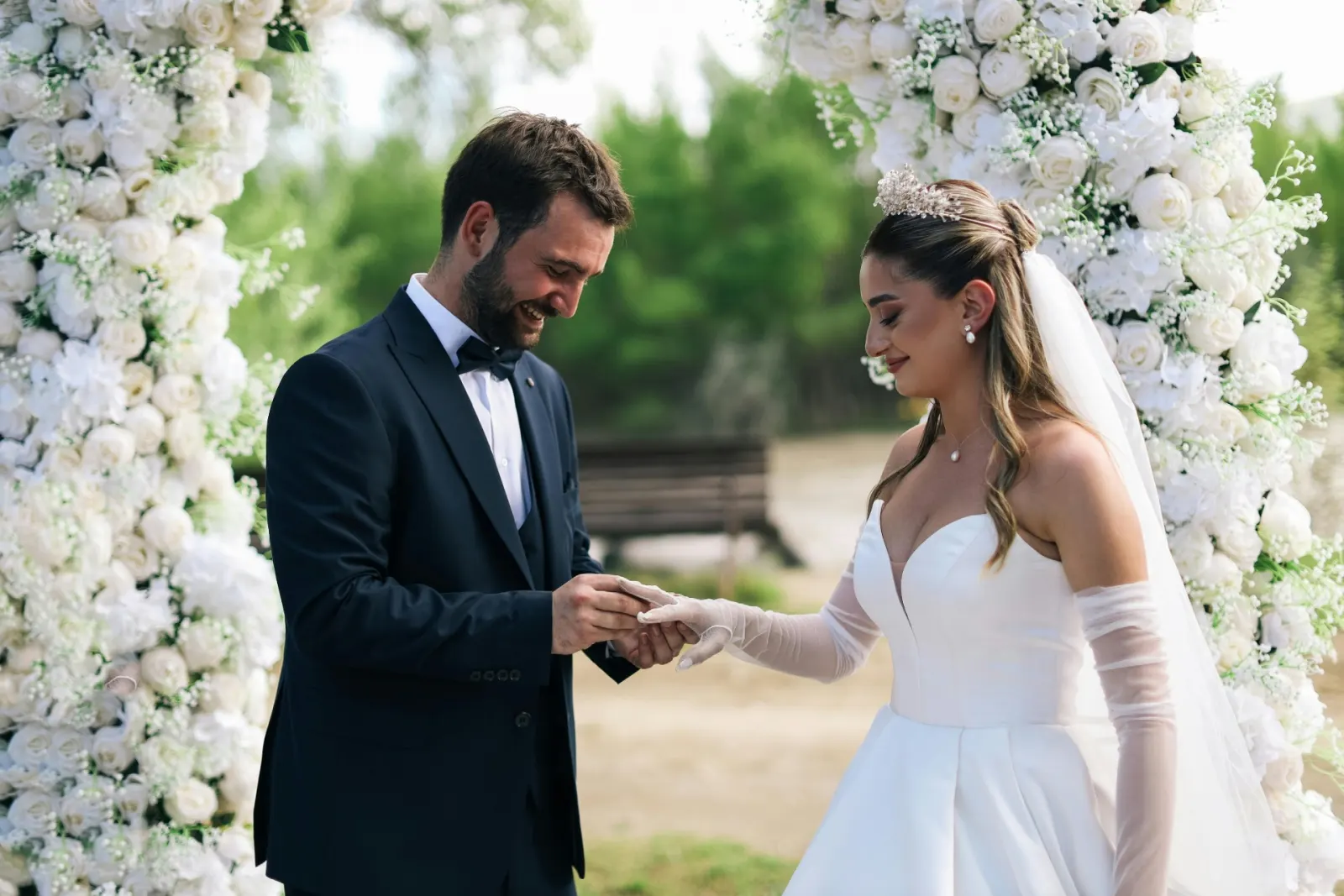
A wedding ceremony script is one of those things many people do not think about in detail until they suddenly have to.
From a guest seat, a ceremony can look seamless. People walk in, music happens, the officiant says meaningful things, the couple says meaningful things, rings appear at the correct moment, everyone looks slightly emotional, and the whole thing moves forward with the calm confidence of an event that has apparently always known what it was doing. From inside the planning process, the ceremony script looks rather different. It is a sequence of choices, transitions, spoken cues, emotional tone decisions, and timing questions, all sitting inside one deceptively simple problem: what, exactly, are we going to say, and in what order, so this feels like us rather than like a borrowed form with our names dropped into it?
That is the real job of the script.
Not just to fill time. Not just to give the officiant something to hold. A wedding ceremony script gives shape to the most meaningful spoken part of the day. It turns a general idea of "the ceremony" into an actual live experience with pacing, warmth, logic, and some sense of who these people are. It holds the couple, the guests, and the meaning of the moment in one structure.
Which is why it helps to take it seriously.
A ceremony script does not have to be grand to be moving. It does not have to be long to feel complete. It does not have to sound formal in a stiff way, or spiritual in a generic way, or deeply personal in every line. What it does need is shape. Most ceremony problems are shape problems. Something comes too early, runs too long, sounds borrowed, overexplains the obvious, gets sentimental in a way that feels pasted in, or leaves the officiant carrying an emotional load the wording has not really earned. A strong script solves those problems before anyone walks down the aisle.
This is also why a good ceremony script is more than one sample pasted into a page. Most people searching this topic do not just want words. They want a reliable structure, a sense of what belongs where, and enough sample wording to get moving without feeling trapped inside a script that sounds like everybody else's ceremony.
That is what this guide is for.
It is built to help with the full ceremony arc:
- what a wedding ceremony script includes
- what each section is doing
- what to keep, change, shorten, or omit
- how officiant wording should sound
- where vows fit
- where rings fit
- what optional pieces are actually worth considering
- how to make the whole thing feel coherent, personal, and sayable out loud
Need help writing your vows? Evermore can help turn your relationship, tone, and actual life together into vows that feel specific, personal, and good to say in the room.
Need Help Writing Your Vows?
Turn your relationship and ideas into personalized vows that feel natural to say out loud.
Try for free
What is a wedding ceremony script?
A wedding ceremony script is the spoken framework for the ceremony itself.
That includes:
- the officiant's words
- the order of events
- transitions between sections
- the couple's responses
- vow placement
- ring exchange wording
- pronouncement wording
- optional readings, blessings, or unity elements
In other words, it is both structure and language.
Some couples imagine a ceremony script as a formal document their officiant quietly handles in the background. Sometimes that is true. Other times the officiant is a friend or family member who needs more help. Sometimes the couple is writing large parts of it themselves. Sometimes they are adapting a basic structure from scratch. The point is not who physically types the document. The point is that someone needs to decide how the ceremony actually works as a spoken event.
That is where the script comes in.
Who usually needs a wedding ceremony script?
Usually:
- couples writing or shaping their own ceremony
- friend or family officiants
- officiants who want a base structure to customize
- couples who know they do not want a totally generic ceremony but are not sure how to build something better
- people trying to merge tradition, personality, and timing into one coherent flow
Even when a professional officiant is involved, couples often want to understand the anatomy of the ceremony so they can make better decisions. That is one of the reasons this keyword exists at all. People are not just looking for a block of text. They are usually looking for control, clarity, and language that feels less mysterious than the ceremony-planning process often makes it sound.
What makes a good wedding ceremony script
A good ceremony script usually does five things well.
It moves cleanly
The ceremony should feel like it is progressing, not stalling.
It sounds spoken
Ceremony wording is still live language. If it reads like a brochure, the room will feel that.
It suits the couple
Formal, relaxed, spiritual, lightly funny, classic, modern — the script should sound like it belongs to the people getting married.
It keeps proportion
One section should not swallow the others. A welcome should still be a welcome. The about-the-couple section should not turn into a long feature profile. The vows should not arrive exhausted by the time they finally appear.
It leaves room for feeling
Not manufactured feeling. Earned feeling. A ceremony script should help the emotional weight arrive naturally rather than trying to impose it every other line.
The basic anatomy of a wedding ceremony script
Most ceremonies work best when they follow a recognizable arc.
A strong basic structure often looks like this:
- Processional
- Welcome
- Acknowledgment of guests / significance of the gathering
- Optional reading
- A short section about the couple or the meaning of marriage
- Declaration of intent / "I do" moment
- Vows
- Rings
- Optional blessing / closing reflection
- Pronouncement
- Kiss
- Presentation / recessional
Not every ceremony needs every piece. But this is a useful skeleton because it gives the event a beginning, development, commitment point, and close.
Processional
The processional is less about wording and more about sequence, but it still belongs in the script because the officiant may need to cue the room.
Typical wording may be minimal:
Please stand for the bride.
Or:
Please rise.
Sometimes nothing is said because the music and coordinator handle the movement. Sometimes the officiant makes a brief cue. Keep it clean.
The key thing is not to overtalk the processional unless the ceremony style calls for it. The event has not emotionally begun in full until everyone is in place.
Welcome
This is where the ceremony truly starts.
The welcome should:
- ground the room
- acknowledge the occasion
- establish tone
- avoid overexplaining
A good welcome is usually shorter than people think. It does not need to be vague and poetic for three paragraphs to sound meaningful. It needs to sound like someone confidently beginning a real ceremony.
Sample welcome wording
Hello, and welcome. We are gathered here today to celebrate the marriage of [Name] and [Name], and to witness the promises they are about to make to one another.
That is enough for some ceremonies.
A slightly warmer version:
Welcome, everyone. Thank you for being here to celebrate [Name] and [Name]. It means a great deal to gather the people who know and love them as they begin this next chapter of their life together.
This section works best when it opens the room rather than trying to win it.
Acknowledging the guests
This is where some ceremonies naturally broaden a little and recognize that weddings are not only private promises. They are also witnessed commitments, and that witness matters.
Useful themes here:
- gratitude for the guests' presence
- the role of family and friends
- the sense of shared celebration
- remembrance, if there are absent loved ones to acknowledge
Sample wording
Thank you to all of you for being here today. Your presence matters. The people gathered here are part of the story of this couple's life, and your love and support help shape the marriage they are beginning today.
This section should still stay proportionate. It is easy to turn acknowledgments into a second welcome.
Optional reading
A reading is useful when it genuinely adds tone, reflection, or voice to the ceremony.
It can be:
- a poem
- a short literary passage
- scripture
- a prayer
- a philosophical or secular reflection
- something family-written, if the quality is there
What helps:
- keeping it short
- choosing something that fits the couple
- placing it where it supports the ceremony rather than delays it
A reading at this point often works well because it deepens the atmosphere before the more couple-specific sections begin.
Officiant transition into a reading
To help mark the meaning of this moment, [Reader Name] will now share a reading.
Simple is often best.
The "about the couple" section
This is where many scripts get weaker than they need to.
This section is often the most personalized one, and therefore the most likely to become long, repetitive, or over-written. Its job is usually to answer some version of:
- who are these people together?
- what is meaningful about this relationship?
- why does this ceremony matter for them?
It does not need to become a full love-story documentary.
A good "about the couple" section is usually:
- personal
- restrained
- specific
- under five minutes
- rooted in observation rather than flattery alone
Sample direction
[Name] and [Name] have built a relationship marked by warmth, honesty, humor, and deep trust. The life they are choosing today is not built only on love in the abstract, but on the daily ways they care for one another, make each other laugh, and continue returning to the same shared commitment.
That tone tends to work better than writing that sounds as if the officiant temporarily became a novelist.
Declaration of intent
This is the "I do" section, or some close equivalent.
It matters because it is the formal consent moment. In some places, a version of this is legally required. Even where it is flexible, it gives the ceremony a clear hinge between reflection and commitment.
Classic wording
[Name], do you take [Name] to be your lawfully wedded [wife/husband/partner], to love and cherish from this day forward?
I do.
Simpler modern wording
[Name], do you choose [Name] to be your partner in marriage, to love, support, and stand beside from this day forward?
I do.
This is one of the places where the script can stay very clean. It does not need embellishment to work.
Vows
For many couples, this is the emotional center.
Vows can be:
- repeated after the officiant
- read from prepared pages
- traditional
- custom
- a hybrid of both
The job of the ceremony script here is to:
- set them up clearly
- make room for them
- avoid exhausting the moment before it arrives
A simple transition:
[Name] and [Name] will now share the vows they have written for one another.
Or:
[Name] and [Name], please repeat after me.
If the couple wants classic wording, something inspired by traditional wedding vows may be the right fit. If they want more personal language, Evermore's wedding vows flow can help them shape wording that sounds more like their actual relationship.
If the couple wants something further from traditional phrasing — vows that feel more written for them than chosen from a list — our unique wedding vows examples page is a useful reference for what that range can actually sound like.
Start Your Vows
Answer a few questions and get a vow draft shaped to your relationship and tone.
Try for free
Optional mini-ceremony or unity element
This is optional for a reason.
Common examples:
- candle lighting
- handfasting
- sand ceremony
- wine box or letter ceremony
- tree planting
- cultural or religious rituals
These can be lovely when they:
- fit the couple
- are explained briefly
- add something real to the ceremony
They are less useful when included simply because people think the script needs "something else." Most ceremonies are already complete without a unity element.
If one is included, keep the wording concise and make sure it belongs to the couple's actual taste and style.
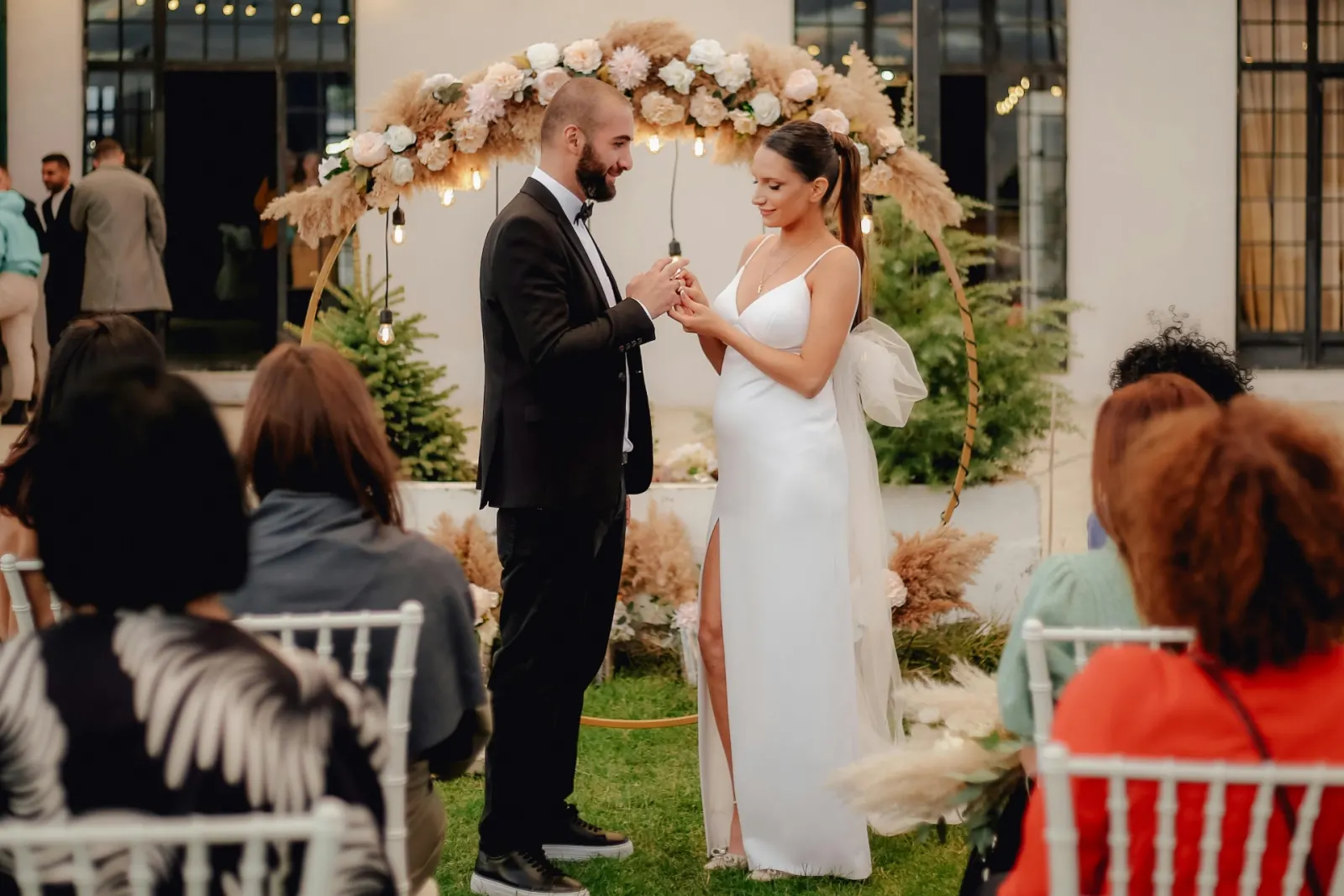
Ring exchange
The ring exchange is usually one of the simplest and strongest parts of the ceremony. The wording benefits from staying clear.
Sample wording
[Name], please place the ring on [Name]'s finger and repeat after me:
I give you this ring as a symbol of my love, my commitment, and the life we will share together.
Or a simpler version:
With this ring, I choose you again and again.
This section works best when it does not try to out-poetic the vows.
Blessing or closing reflection
Some ceremonies want a formal blessing. Others want a secular closing reflection. Others want neither.
If included, this section is usually the final emotional framing before the pronouncement.
Sample secular closing reflection
May the promises spoken here today continue to deepen through the ordinary and extraordinary days ahead. May your marriage be marked by kindness, honesty, laughter, and the steady comfort of being known and loved.
Sample blessing tone
May your marriage be blessed with patience, joy, faith, and enduring love.
This section should feel like a closing arc, not a second sermon.
If this is a renewal rather than a first wedding, the same ceremony shape still works, but the framing usually shifts — our vow renewal ceremony guide covers how the wording tends to change when the marriage already exists.
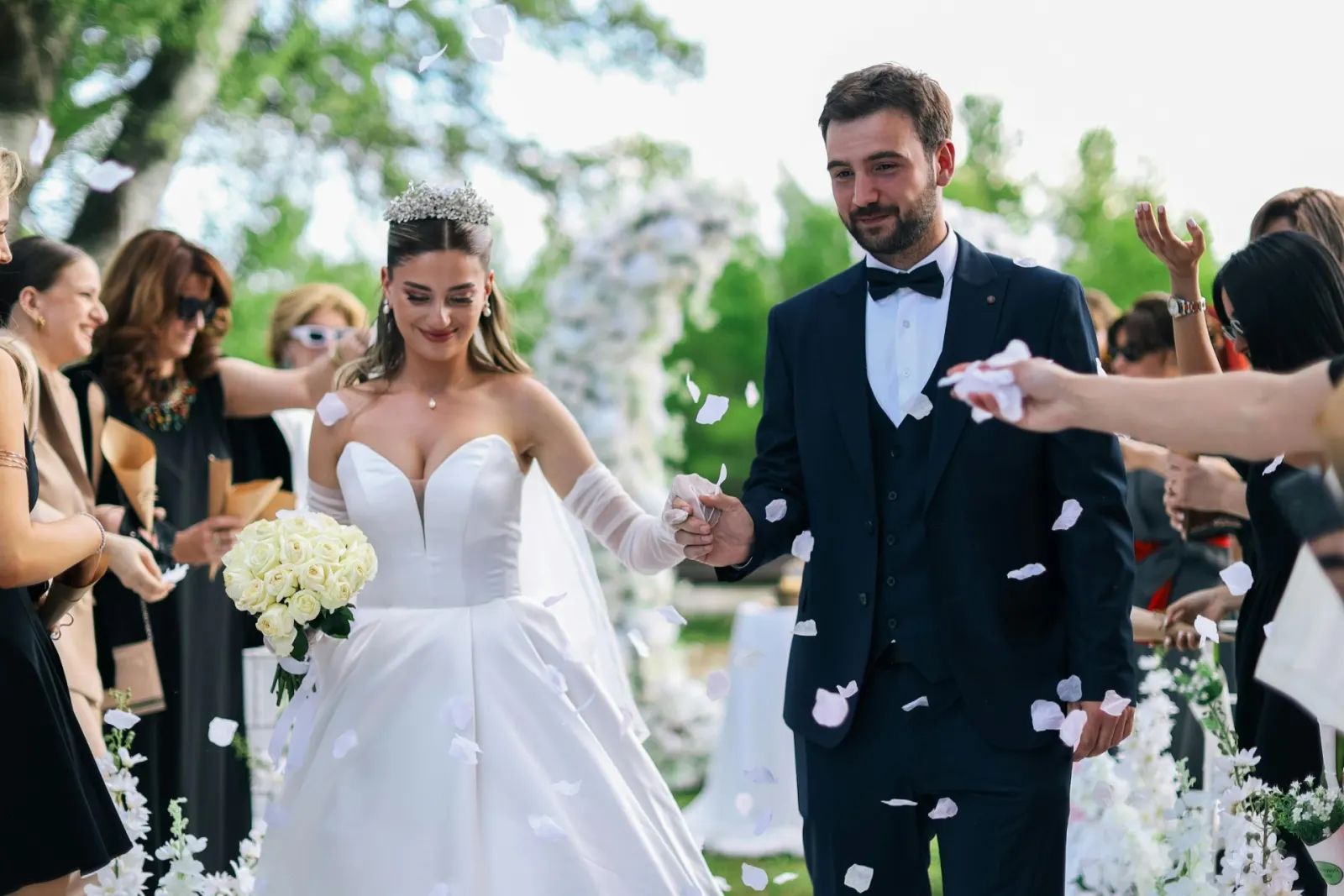
Pronouncement, kiss, and presentation
This is the ceremonial finish.
Traditional pronouncement
By the authority vested in me, I now pronounce you married.
More personal modern wording
It is my great joy to pronounce you married.
Then:
You may kiss.
Then:
It is my honor to present to you [Name] and [Name].
This part should move cleanly. The emotional climax has already happened. The room is ready for completion.
A complete sample wedding ceremony script
Below is a strong, adaptable base script that can be customized.
Sample script
Welcome
Welcome, everyone. Thank you for being here today to celebrate [Name] and [Name]. We are gathered to witness their marriage and to share in this moment with the people who know and love them best.
Acknowledgment of guests
Your presence here matters. The love, friendship, and support of family and friends help shape the life a couple builds together, and it means a great deal that you are here to witness these promises today.
Optional reading introduction
To help mark the meaning of this moment, [Reader Name] will now share a reading.
About the couple
[Name] and [Name] have built a relationship grounded in care, honesty, humor, and deep mutual respect. What brings them here today is not only love, but the daily choice to keep building a life together — one marked by trust, partnership, and the quiet confidence of being fully known.
Declaration of intent
[Name], do you take [Name] to be your partner in marriage, to love, support, and stand beside from this day forward? I do.
[Name], do you take [Name] to be your partner in marriage, to love, support, and stand beside from this day forward? I do.
Vows
[Name] and [Name] will now share their vows.
Ring exchange
Please place the ring on [Name]'s finger and repeat after me: I give you this ring as a symbol of my love, my commitment, and the life we will share together.
Closing reflection
May the promises spoken here today continue to deepen with time. May your marriage be marked by kindness, steadiness, laughter, and the joy of continuing to choose one another.
Pronouncement
It is my great joy to pronounce you married.
Kiss
You may kiss.
Presentation
It is my honor to present [Name] and [Name].
How to customize the script without ruining it
A few useful rules:
Change tone, not just words
You do not need to replace every sentence. You need the script to sound like the ceremony you are actually having.
Keep the bones strong
The structure works for a reason. Personalize within it.
Do not overfill every section
A ceremony gets stronger from selectivity.
Match the voice to the speaker
A friend officiating should not sound like a courthouse manual. A very formal religious officiant should not sound like casual brunch remarks.
Read the whole thing aloud
Ceremony language has to work in air, not just in a document.
How long should a ceremony script be?
It depends on the ceremony, but a useful general range is:
- about 15 to 25 minutes for many ceremonies
- longer if there are multiple readings, music pieces, or unity rituals
- shorter for intimate ceremonies or minimal formats
The easiest way to lose the room is not by having one weak sentence. It is by failing to edit overall length.
The sections most likely to run long are:
- about the couple
- readings
- officiant reflections
- optional mini-ceremonies
That is where discipline matters most.
For friend or family officiants
This is where many readers really need help.
A friend or family officiant often has:
- emotional closeness
- good intentions
- very little experience with live ceremony pacing
That combination can be lovely. It can also create scripts that are too long, too private, too flattering, or too uncertain in flow.
If you are officiating for friends or family:
- keep the couple section tight
- explain transitions clearly
- avoid making it about your relationship to the couple
- remember you are holding the room, not guest-starring in it
- rehearse out loud
The strongest friend-officiated ceremonies usually sound personal and competent at the same time.
Common mistakes to avoid
Overwriting the welcome
The ceremony does not need to begin with a long attempt at grandeur.
Making the "about the couple" section too long
This is probably the most common problem.
Using sample wording without adapting the tone
Borrowed wording often sounds borrowed. For couples writing their own personal language, wedding vows examples can be a useful place to see how real personalization sounds.
Adding too many optional elements
Not every ceremony needs a reading, blessing, unity ritual, and additional reflection.
Writing for the page instead of the room
The ceremony is spoken, live, and public.
If you want to write personal wedding vows rather than borrow language wholesale, Evermore can draft personalized vows in three tones based on your story — preview them free before you pay.
Frequently asked questions about wedding ceremony scripts
What is a wedding ceremony script?
A wedding ceremony script is the spoken framework for the ceremony, including the officiant's wording, the order of events, and the couple's responses.
What should be included in a wedding ceremony script?
Usually: welcome, acknowledgment of guests, optional reading, about-the-couple section, declaration of intent, vows, rings, optional blessing, pronouncement, kiss, and presentation.
How long should a wedding ceremony script be?
Often around 15 to 25 minutes, depending on the ceremony style and how many optional elements are included.
Do you need a script if a friend is officiating?
Yes, absolutely. A script helps the ceremony feel clear, coherent, and easier to deliver.
Can a wedding ceremony script be non-religious?
Yes. Many ceremony scripts are secular, lightly spiritual, or personalized to the couple's beliefs.
Do the vows go inside the script?
Yes. The script should include where vows happen and how they are introduced, even if the vows themselves are written separately.
Final thoughts
A good wedding ceremony script does not exist to sound impressive on paper.
It exists to carry a real moment well.
That means it should feel structured, clear, emotionally coherent, and true to the couple. It should let the ceremony breathe. It should support the officiant. It should make room for the vows. And it should sound like something real people would actually want to hear in a room when a marriage is beginning.
That is the standard worth aiming for.
And it is usually much more achievable once the script stops being treated like a mystery and starts being treated like what it really is: a carefully shaped piece of live language.
Need help writing your vows?
If you want help with the most personal part of the ceremony, Evermore can help.
With Evermore, you can:
- answer a few thoughtful questions
- choose your tone
- get a personalized draft
- revise until it feels right
- preview it before you pay
It is the easiest way to turn your relationship into vows you would genuinely feel good saying.
Create Your Vows Now
See your preview before you pay.
Try for free
Generate Your Wedding Vows Now
See your preview before you pay.
Try for free
Related Articles
Wedding Vows · May 7, 2026
Traditional Wedding Vows: Wording & Examples
What traditional wedding vows actually say, the classic and lightly modernized wording couples use today, and how to choose the version that fits your ceremony.
Wedding Vows · April 4, 2026
Wedding Vows Examples: Romantic, Short, Funny & Modern
Romantic, short, funny, simple, and modern wedding vows examples, plus a personalizable template and tips for writing vows that actually sound like you.
Wedding Vows · April 4, 2026
How to Write Wedding Vows: The Ultimate Step-by-Step Guide
A complete step-by-step guide to writing wedding vows that are personal, clear, and emotionally honest, with structure, examples, tips, and common mistakes to avoid.
Wedding Vows · April 4, 2026
Wedding Vows for Him: Romantic, Short, Funny & Simple Examples
Romantic, short, funny, and simple wedding vows examples for him, plus a personalizable template and tips for writing vows that actually sound like you.
Wedding Vows · April 5, 2026
Wedding Vows for Her: Romantic, Short, Funny & Simple Examples
Romantic, short, funny, and simple wedding vows examples for her, plus a personalizable template and tips for writing vows that actually sound like you.
Wedding Vows · April 18, 2026
Wedding Vows Template: Fill-in-the-Blank Guide
A practical fill-in-the-blank wedding vows template with section-by-section wording help, short and longer versions, promise lines, and openings and closings you can adapt.