How to Write a Sister of the Groom Speech

By Claire Bennett · Senior Wedding Editor, Evermore
The first draft of a sister of the groom speech often sounds less like a speech than a pile of evidence.
Evidence that you know him too well. Evidence that he was once impossible at twelve. Evidence that he improved. Evidence that you have access to stories other people in the room definitely do not. Evidence that affection between siblings rarely arrives in a clean, ribboned form and is much more likely to show up wearing sarcasm and pretending not to care very much.
That is where the real writing problem lives.
It is not really "how do I say nice things about my brother?" Most sisters can do that eventually. The trickier part is deciding what version of that knowledge belongs in a wedding speech. This role can go wrong in opposite directions very quickly. It can become too private and feel like the audience is eavesdropping on a family kitchen conversation. Or it can overcorrect into generic wedding language and lose the one thing that made it worth giving to you in the first place: the fact that you know him from the inside.
That is why this speech is not just a sibling speech. It is a filtering exercise.
You are not trying to squeeze your entire history with him into five minutes. You are trying to choose a handful of details, a tone, and a point of view that make the room understand something true about him now, on this day, in a form that still sounds like you.
That matters, because a good sister of the groom speech is not mainly about proving closeness. The room already assumes you have that. What they need from you is a useful angle. Something only you can say, but said with enough taste that it still belongs in a public celebration rather than a family-only afterparty where everyone is standing in the kitchen with their shoes off.
This page is here for that exact job.
Not to give you a giant block of sample speeches. That is what the sister of the groom speech examples page is for. Not to hand you a fill-in-the-blank framework and send you on your way. That is what the sister of the groom speech template page is for. This page is about process. How to think your way into the speech. How to decide what kind of sister you are on a microphone. How to choose material that sounds affectionate instead of chaotic, funny instead of feral, proud instead of ceremonial, and human instead of suspiciously "wedding."
Start Your Sister of the Groom Speech
Answer a few questions and get a personalized sister of the groom speech in minutes.
Try for free
What this role sounds like when it's done well
A strong sister of the groom speech usually has a particular kind of tone that other roles do not quite have.
It is often warmer than a best man speech, but slightly less performative. More familiar than a parent speech, but usually less ceremonial. More allowed to be dry. More allowed to reveal the groom's edges. More able to show history without explaining all of it. And, ideally, more interested in the man standing there now than in the child he once was, unless that child is being used very selectively for contrast.
That is the word to keep in mind: selectively.
This role does not need full access.
It already has it.
What it needs is judgment.
If you want to hear how this role can work in the real world, this is a useful sister of the groom speech with warmth, humor, and just enough bite.
What the speech is actually there to do
This is worth settling before you write a line, because a lot of sibling speeches go wrong by taking on extra jobs they were never asked to do.
A sister of the groom speech is not there to:
- settle scores from childhood in a charming way
- prove how close you are by sheer quantity of memory
- become a smaller best man speech
- become a more casual mother-of-the-groom speech
- or serve as an oral history of the family with one romantic paragraph added near the end
Its real job is simpler.
A good version usually does four things:
- gives the room one memorable truth about the groom
- lets the sibling bond be felt without drowning everyone in private lore
- acknowledges the partner in a way that feels genuine
- lands somewhere warm, proud, and appropriately public
That last phrase matters: appropriately public.
There are things that are true and things that are usable. The skill here is knowing the overlap.

Decide who your brother is in this speech
Not in life. In the speech.
That may sound odd, but it helps immediately.
You know too many versions of him:
- the annoying one
- the hilarious one
- the one who never texted back
- the one who carried more than he admitted
- the one who was impossible in adolescence
- the one who became unexpectedly solid
- the one who now stands in suits and says things like "we should compare mortgage rates," which is frankly a lot to process if you once watched him eat cereal directly from the box
You do not need all of them.
Pick the version that serves the moment.
Maybe in your speech he is:
- the quietly reliable one
- the unexpectedly thoughtful one
- the funny one with real steadiness underneath
- the person people lean on
- the brother who grew into himself
- the man who is best understood through how he shows up for other people
- the person who became especially clear once he met his partner
Once you choose that version, the writing gets easier because you stop trying to represent the entire archive. You start curating.
A useful sentence to finish before you draft is: The truest thing I want the room to understand about him is…
Keep writing until you get to something that sounds like a sentence you would actually stand behind.
Don't start with childhood unless childhood is doing real work
This is one of the most common sibling-speech mistakes.
People reach for the past first because it is the easiest source of material. Unfortunately, it is also where the most disposable material lives. Childhood stories can be funny, yes. They can also instantly age a speech down if they are not doing anything except proving that you were both young once and occasionally weird.
A childhood memory belongs if it:
- reveals the adult person clearly
- explains a lasting quality
- creates contrast with who he is now
- or lands a joke without making the entire speech feel underdeveloped
It does not belong if it is:
- just embarrassing
- just chaotic
- just cute in a way that only family finds moving
- or so detailed that the room starts doing mathematics to work out why it matters
Good sibling writing often uses the past sparingly. Enough to establish texture. Not so much that the groom starts to vanish behind earlier versions of himself.
Choose one story that does more than one job
The best speech story is often the one that quietly handles multiple things at once.
Ideally, it:
- shows who he is
- gives the speech some life
- sounds like you would tell it
- lets the room in
- and leaves him looking more lovable than ridiculous
That is a much higher bar than "good story," which is why choosing the right one matters.
Ask:
- does this story reveal character, not just history?
- is it short enough to survive a live room?
- does it make sense if people do not know the family background?
- does it give me a way to move toward the partner and the wedding, or does it trap me in the past?
- if I tell this, does he still sound like a man someone is lucky to marry?
That last one is a useful filter. It prevents a lot.
A sister speech can absolutely tease him. It just should not accidentally make the audience think, "Interesting choice from the bride."
Create Your Sister of the Groom Speech
Get a personalized draft based on your relationship, memories, and tone.
Try for free
Decide how dry you want to be
Many sister of the groom speeches work well with some dryness. Not all. But many.
Dryness helps because sibling affection often sounds more believable when it is not fully polished. A little side-eye. A little understatement. A line that suggests, "I know exactly who you are, unfortunately for you," while still making the love underneath it obvious.
But dryness needs control.
There is a difference between:
- one line that lightly punctures the room in a helpful way
and
- a speech that behaves like you were handed a microphone so you could finally air a decade of notes.
A good rule:
Every joke should make him sound more recognisable, not less admirable.
You are not trying to be flattering at all costs. That feels fake. But you are trying to be loving in public. The speech should leave him more fully seen, not merely more fully exposed.
If you are unsure whether a joke crosses the line, ask:
Would this still feel generous if someone hearing me had never met us before?
If the answer is no, it may belong in the car on the way home instead.
Let the partner arrive before the speech starts to lean
This is where some sibling speeches lose their balance.
They spend three or four paragraphs on the brother, the family, the old stories, the old habits, the old house, the old version of the world. Then they remember, with twenty seconds left, that the wedding has introduced another person who matters quite a lot here.
Do not do that.
The partner should not feel like a legal requirement stapled on to the emotional history. She should feel like part of the speech's logic.
That does not mean your speech has to become romantic in a way that does not suit you. It just means that at some point you should say something real about:
- what it has been like to watch them together
- what she brings out in him
- what kind of ease, steadiness, warmth, humor, or honesty exists between them
- why this marriage makes sense from the perspective of someone who has known him longest
That is often where the speech lifts.
Because a sister can say something distinct here. Not "they're perfect together." That tells nobody much. Better:
- he seems calmer with her
- he seems more fully himself
- she understands him in ways that are reassuring to watch
- they make each other both lighter and steadier
- their relationship feels easy in a good way, not a lazy one
Those are useful observations. They sound lived-in rather than ceremonial.
Use this structure
Once you know your angle, your story, and your tone, use this shape:
1. Opening
Say who you are and begin cleanly.
2. Your main point about him
Give the room the central thing you want them to understand.
3. One short story or reflection
Use a moment that proves the point.
4. Bring in the partner
Say one or two true things about the relationship.
5. Widen slightly
A brief line of pride, hope, or perspective.
6. Toast
End clearly.
That is enough for a very good speech.
Notice what is not in that structure:
- long family administration
- multiple stories
- a second emotional arc
- filler
- a prolonged explanation of why siblings are complicated
The room already knows siblings are complicated. That is part of the entertainment value. You do not need to explain the concept. You need to choose from within it.
Write the opening last if it helps
Many people get stuck on sentence one and stay there much longer than necessary.
The opening is important. It is not where the speech lives.
A useful sister-of-the-groom opening should sound like:
- you
- in public
- on purpose
That is all.
Good options:
- Hi everyone. I'm [Name], [Groom's Name]'s sister, and I'm very happy to be speaking tonight.
- Good evening. I'm [Name], [Groom's Name]'s sister, and it means a lot to be here tonight.
- Hi everyone. I'm [Name], and as [Groom's Name]'s sister, I've known him in a wider range of forms than most people in this room.
That third version works if the speech is lightly dry. The point is not to find an "iconic" opening. The point is to get the room with you and then move into the substance before the speech becomes self-conscious.
Give him one paragraph that sounds like he could only be him
This is the test worth applying.
If the paragraph could be moved to another groom's page with only a name change, it is not specific enough yet.
What you want is something like:
- One of the things I admire most about him is how quietly reliable he is.
- He has a way of making people feel looked after without turning it into a performance.
- He's funnier than he advertises and steadier than he gets credit for.
- He has always been the person people lean on, sometimes before they've even realised that is what they're doing.
Those lines work because they carry the texture of a known person.
What tends to flatten:
- he's one of the most amazing people I know
- he deserves the world
- I can't believe how grown up he is
- he's always been my best friend
Some of those may even be true. They are just too broad to do much work.

Let one line stay a little rough around the edges
This is a smaller point, but it helps.
Not every sentence in a wedding speech should be polished into symmetry. Especially not in a sister speech. If everything is too balanced, too neat, too ready for engraving, the speech starts to lose credibility.
A slightly more spoken line can help:
- I've known for a long time that he matters deeply to people. It's just especially nice to stand here and watch that so clearly.
- He has always been easier to love than to summarize, which is inconvenient for me tonight.
- There are lots of things I could say, but the useful version is that he's a very good man.
Those feel more lived-in.
They sound like someone speaking, not someone drafting wall art.
Edit with the room in mind, not just the relationship
This is probably the most important revision pass.
Ask of each section:
- would this make sense to someone who does not know our family dynamic?
- is this too private to be public, even if it is true?
- is this joke a room joke or a sibling joke?
- have I kept enough of him as he is now?
- has the partner arrived in time?
- does this feel warm enough?
- does it feel too polished?
- is there any paragraph here that only exists because I like what it proves about my access?
That last question is useful, because one temptation in sibling speeches is to prove proximity. But proximity is not the same thing as usefulness. The room does not need to be convinced you know him best. They need to be shown something worth knowing.
Practice out loud before you trust the draft
A sentence can look perfectly fine and still die the second it meets your mouth.
That is not a small detail. It is the whole medium.
Read it out loud and notice:
- where you rush
- where the line feels too formal
- where the joke is too private
- where the emotional section suddenly feels imported
- where the ending trails instead of lands
The spoken version tells the truth about the speech much faster than the document does.
If something sounds slightly fake when spoken, it usually is. If a line sounds too polished for your actual voice, simplify it. If you keep stumbling on a sentence, it may be trying to be more elegant than useful.
The goal is not perfection. It is believability.
If you don't want to sound overly sentimental
You do not have to.
A good sister of the groom speech can be moving without ever becoming openly gooey. Some of the best ones are emotionally clear and tonally restrained. They let the affection sit in the choices rather than in big declarations.
Instead of:
- You mean everything to me.
- There are no words for how much I love you.
- I'm overwhelmed with emotion tonight.
Try:
- I'm very proud to be your sister.
- It means a lot to stand here and say this.
- I could not be happier for you.
- I've always known you'd matter deeply to people. It's lovely to get to say that out loud tonight.
Those lines still carry feeling. They just do it in a way that sounds more like a person and less like a secondhand keepsake.
If you need extra support
If what you want next is:
- structure, go to the sister of the groom speech template
- examples, go to the sister of the groom speech examples
- the brother counterpart, see the brother of the groom speech template
- a broader look at what speeches sound like in other roles, go to the wedding speech examples page, or the wedding speech template
- related sibling generator pages: sister of the bride speech, brother of the groom speech, or the groom speech itself
- a personalized draft built around your own relationship and tone, start with Evermore's sister of the groom speech generator
This page is the process page. Its job is to help you think clearly enough that whatever you build next actually sounds like it belongs to you.
Frequently asked questions about how to write a sister of the groom speech
Should a sister of the groom speech be funny?
Usually a little, if that fits your voice. This role often benefits from some light teasing or dry observation, but the humor should stay affectionate.
How long should it be?
Usually around 3 to 5 minutes is enough. Most speeches in this role improve when they stay concise.
Do I need to tell a childhood story?
Not necessarily. If you use one, it should reveal something useful about who he is rather than just proving that you remember him at eleven.
How do I keep it from sounding childish?
Focus on the man he is now, keep the teasing controlled, and avoid stories that are funny only because the family shares the entire backstory.
Do I need to mention the partner directly?
Yes. The speech feels fuller and more generous when the relationship is visible rather than implied.
What if I'm nervous?
Use a simple structure: opening, one point, one short story, one line about the couple, toast. That is enough.
Final thoughts
Writing a sister of the groom speech is mostly about deciding what kind of sister you want to be in public for four minutes.
Not a fake one.
Not a softened one.
Not the most entertaining possible one.
Just the version of you that can say something true, affectionate, and well judged in a room where other people matter too.
That is what makes the speech work.
You are not trying to empty the whole history out onto the floor. You are choosing a few pieces of it carefully enough that the room can feel both the length of the relationship and the intelligence of your editing.
That combination is usually what people remember:
not the biggest laugh,
not the most tearful line,
but the speech that felt alive and properly meant.
Need help writing your sister of the groom speech?
With Evermore, you can:
- answer a few thoughtful questions
- choose your tone
- get a personalized draft
- revise until it feels right
- preview it before you pay
It is the easiest way to turn a messy set of memories, instincts, and decent intentions into a speech you would genuinely feel good saying.
Generate Your Sister of the Groom Speech Now
See your preview before you pay.
Try for free
Related Articles
Maid of Honor · April 18, 2026
Sister of the Bride Speech Template
A practical fill-in-the-blank sister of the bride speech template with section-by-section wording, short and longer versions, toast lines, and lines to borrow when you are stuck.
Sibling Speeches · May 2, 2026
Sister of the Groom Speech Template
A fill-in-the-blank sister of the groom speech template with wording help, short and fuller versions, toast ideas, and section-by-section guidance.
Sibling Speeches · May 3, 2026
Sister of the Groom Speech Examples & Toasts
Sister of the groom speech examples — full samples, openings, lines about the groom and the couple, and what tends to work for this role.
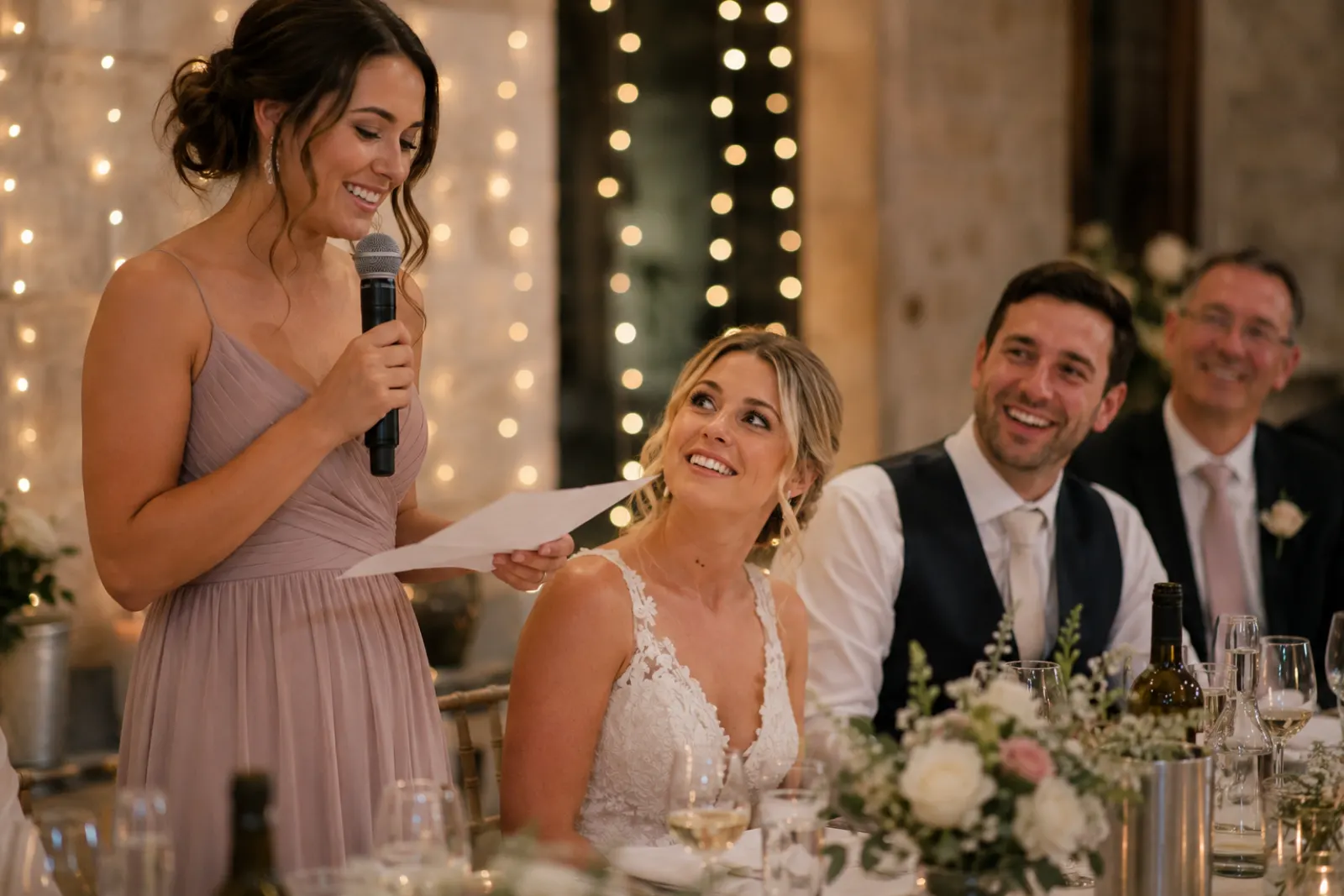
Speech Examples · May 23, 2026
Sister of the Bride Speech Examples: Funny & Warm
Eleven sister of the bride speech examples across warm, funny, short, emotional, older-sister, and younger-sister tones — plus sister-specific lines you can adapt.
Best Man Speeches · April 4, 2026
How to Write a Best Man Speech: Ultimate Step-by-Step Guide
Everything you need to write a best man speech from scratch — structure, examples, humor tips, delivery advice, and common mistakes to avoid.
Father of the Bride · April 8, 2026
How to Write a Father of the Bride Speech: Ultimate Step-by-Step Guide
A complete step-by-step guide to writing a father of the bride speech — structure, tips, examples, what to avoid, and how to deliver it confidently.